¡Hola, Guapa!, ¡Hola, Sabrosa!, Edición No. 8: Healthy Habits, Spanish

Latina y Saludable

En De Las Mías nuestra filosofía es una de orgullo por nuestra comida, nuestra cultura y nuestros cuerpos. Esta es la manera que nos empoderamos para vivir una vida más saludable. No rechazamos nuestras costumbres ni nuestra manera de ser.  Nos aceptamos tal y como somos – todo el paquete – y así seguimos buscando el camino a la buena salud.

Los hábitos son los pilares de la vida y por eso en De Las Mías nos enfocamos en construir hábitos saludables.

Qué la vida saludable sea nuestra costumbre

Qué bonito fuera si pudiéramos vivir nuestras vidas en una manera saludable, como de costumbre. Nuestro camino no se trata de ir al país de los skinny jeans. Se trata de hacer cambios saludables poquito por poquito, siempre con la confianza que vamos a un destino sano y saludable.

Ya basta con las dietas

De Las Mías no es un Club de Dieta, porqué las dietas no funcionan.

Aunque no seamos un Club de Dieta, buscamos una solución sana y moderada al sobrepeso. Somos latinas, y nos queremos sentir guapas y atractivas, pero también sanas y fuertes.
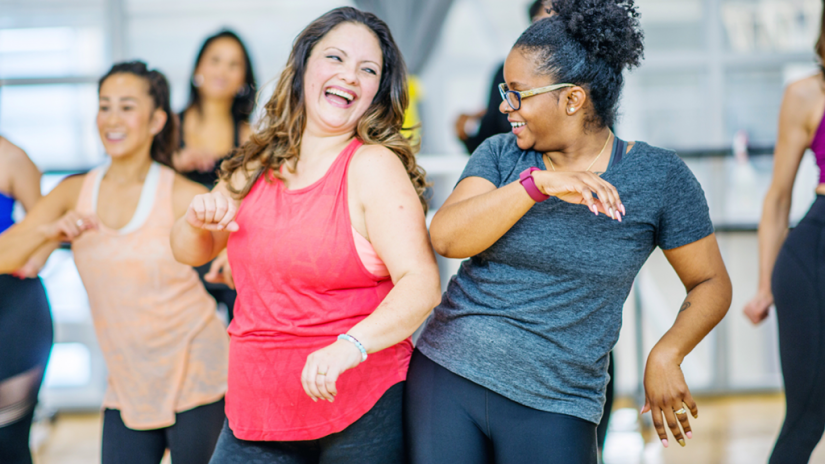
Deja de ponerte en dieta

El dilema del sobre peso tiene solución. Pero repito que ponerte “en dieta” no es la solución. Sé que no me crees así que sigue leyendo…

“¿Tomarías un medicamento que ha fracasado el 95 por ciento del tiempo? Esa es la tasa de fracaso de la mayoría de las dietas tradicionales”. Eso es lo que Rebecca Scritchfield, una dietista licenciada, y autora de “Body Kindness” declara en su libro.

Imagínate, ¡Mujer! Gastamos miles de millones de dólares al año en dietas que no funcionan.

Buscamos la forma mágica de bajar de peso, la dieta mágica…Pero la dieta mágica no existe.

Lo que sí existe es una manera moderada y positiva de llegar a nuestros metas de vivir una vida saludable.

Aquí va: Primero, deja la dieta. Segundo, agrégale el amor propio y el hecho de aceptarte tal y como eres. Tercero, comienza a tomar pequeños pasos saludables y que se te conviertan and hábitos saludables.  Y así formando los buenos hábitos vas a llegar a tu destino de la buena salud. Paso por paso te vas a sentir mejor y vas a lucir mejor. Con el tiempo si sigues tu camino vas a llegar a un peso natural para ti.

Esta técnica te ayudará a construir los hábitos sanos y saludables que te van a durar toda la vida. Si tu dominas estos buenos hábitos poco a poco, vas a sentirte cómo una Super Mujer – Super Poderosa.

Nuestros hábitos y nuestra identidad

Otro concepto que estuve estudiando es de James Clear, autor de “Atomic Habits.” El conecta los hábitos con la identidad personal. Clear declara que para cambiar hábitos, necesitas “integrar” el nuevo comportamiento como si fuera parte de ti. Tiene que formar parte de tu identidad, de lo que eres y de cómo te expresas.

Me acordé de algo que me pasó hace muchos años, cuando mi profesora de escritura, Miriam Sagan, me dio un buen consejo sobre ser escritora.

Quería yo lanzarme como escritora de cuentos y le dije que me preocupaba que nunca me convertiría en escritora porque nunca me iban a publicar mis cuentos. Y me contestó, “Cariño, una escritora no es alguien que se publica. Una escritora es alguien que escribe”.

Al principio, no lo entendí. “No estoy segura de lo que quieres decir”, le dije.

Ella dijo: “La manera de convertirte en una escritora es hacer lo que hace una escritora. Si quieres ser escritora, escribe”.

Desde ese entonces me llamo Escritora. Y sí, se han publicado bastante mis cuentos, pero publicar no me convirtió en escritora. Escribir me convirtió en escritora. Primero tuve que ser dueña de mi identidad como escritora y luego hacer lo que hace una escritora.

Mi hija es otro buen ejemplo. Sada es bailarina. Su identidad está envuelta en ser bailarina. Ella baila. Cuando no baila, no se siente como sí misma. Y eso es porque ella no está haciendo lo que hace una bailarina: bailar.

La ciclista monta su bici. La cocinera cocina. La escritora escribe. ¿Entiendes el rollo?
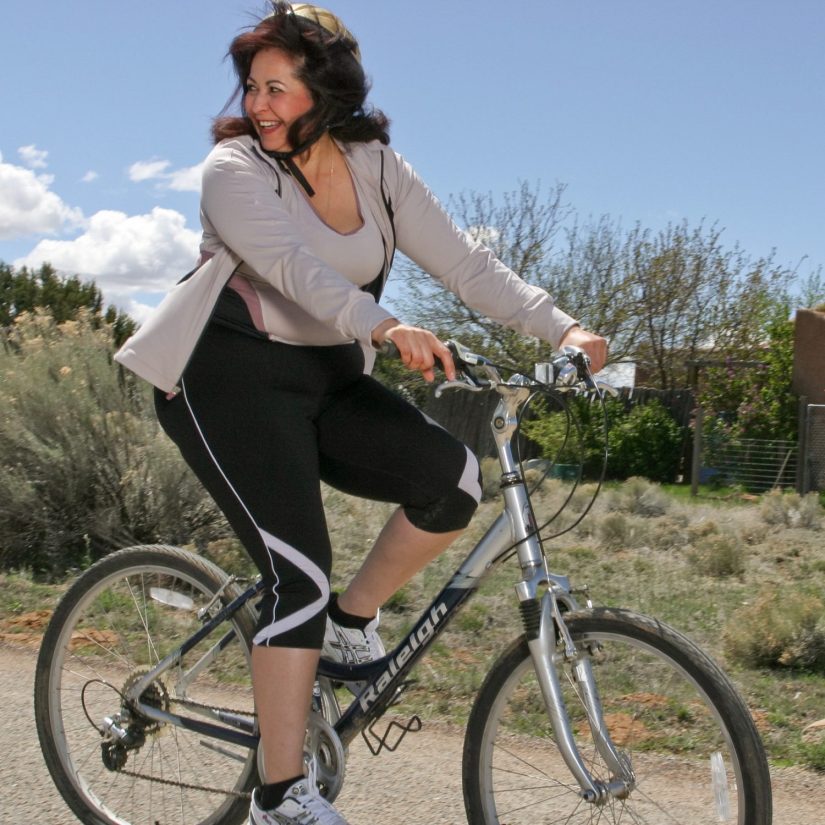
Ahora, hablemos de nuestra identidad como latinas. ¿Qué haces como latina que te hace latina? Piénsalo. Estoy segura de que puedes darnos ejemplos. ¿Cómo te latinas?

¿Eres Mujer Saludable?

Yo me identifico como Mujer Saludable.  Es parte de lo que soy y de lo que hago. ¿Estoy en el “peso ideal” de acuerdo con las cartas de IMC? No. ¿Como donuts? Sí. De vez en cuando. Con un cafecito por favor.

Aunque me coma unas cuantas donuts de vez en cuando, yo me sigo identificando cómo una Mujer Saludable. Y eso es por lo que hago todos los días. Todos los días, como frutas y verduras. Salgo a pasear en mi bici. Doy mis buenas caminatas. Duermo bien. Bebo mis 6 vasos de agua a diario. Esos hábitos son parte de lo que me hacen sentir como Mujer Saludable. Ser saludable es parte de mi identidad. ¿Lo hago todo el tiempo? No. Pero puedo decirte que estos son mis hábitos diarios, mis costumbres. Estos son los hábitos que me convierten en dueña de mi identidad como Mujer Saludable.

Una palabra de precaución sobre las etiquetas y la identidad: Hay tanta investigación que declaran los problemas de salud que los latinos enfrentamos. Estos problemas de salud son reales, pero no son, ni deben ser, parte de nuestra identidad. Por ejemplo, tener diabetes no te convierte en “Una Diabética” – tienes diabetes, eres una persona con diabetes pero tú, querida, no eres Una Diabética.

Declara que quieres identificarte cómo Mujer Saludable. Haz lo que hace una Mujer Saludable. Hazte dueña de esta identidad. (Y no dejes que nadie te dé una identidad que no quieras.)

¿Qué te hace sentirte cómo Mujer Saludable?

¡Dime! ¡Ahora, hazlo!

Comienza hoy y sigue poco a poco.

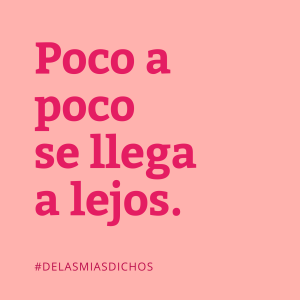
¡Paso por paso se llega a lejos!
 

References: 

Atomic Habits: An Easy & Proven Way to Build Good Habits & Break Bad Ones

Book by James Clear

October 2018

Penguin Random House


Body Kindness: Transform Your Health from the Inside Out–and Never Say Diet Again

Book by Rebecca Scritchfield

December 2016

Workman Publishing


¡Hola, Guapa!, Edición No. 4: Reflection, Healthy Body, Spanish

¿Debo bajar de peso?

¿Debo bajar de peso?

¿Cuántas veces te has hecho esta pregunta? En De Las Mías, nos gustaría que reformularas la pregunta y que te preguntaras:  “¿Debería cuidarme mejor?” Si aún no lo has hecho, lee mi historia, Sobre todo delgada. Esta es una historia personal sobre lo que puede pasar cuando te dedicas a ser, “Sobre todo delgada”.

¿Cómo hemos llegado hasta aquí?

Tal vez tu médico te ha dicho que necesitas bajar de peso para salir de la zona de peligro.  (Diabetes, enfermedades cardíacas, presión arterial alta, algunos tipos de cáncer) Tal vez ya tienes prediabetes. Tal vez tu mamá y tu abuela ya tienen diabetes y tú no la quieres. Tal vez tu novio hace comentarios sobre el cuerpazo de otra mujer y ella pesa 30 libras menos que tú. Tal vez tus jeans son demasiado ajustados y no te sientes bien en ellos. Tal vez quieres parecerte a la J. Lo Tal vez miraste tu IMC.  (BMI en inglés.)

Logrando un peso más saludable y natural

Hay muchas razones, y algunas de ellas son buenas razones, por las que es importante llegar a un peso más saludable y natural, pero etiquetarte a tí misma, comparar tu cuerpo con el de las demás y seguir una dieta de privación loca no te va a llevar allí. Esa es una de las razones por las que estamos abandonando el uso del IMC como una medida de peso saludable.

De Las Mías dejamos de usar el IMC – BMI para evaluar tu peso  

Tradicionalmente, el IMC   – BMI en inglés – se desarrolló como una forma de evaluar si alguiennecesitaba bajar de peso. Por más de 100 años se ha utilizado como una forma de ayudar a evaluar si las personas están en la categoría de “peso saludable”.   El índice de IMC es simplemente un número basado en tu peso y tu altura.   Durante más de 100 años, la premisa general del IMC ha sido que cuanto más alto es tu IMC, más gordura tienes en tu cuerpo. Pero a medida que ha pasado el tiempo, los científicos se han dado cuenta de que el IMC en realidad no mide el porcentaje de grasa, músculo o hueso en el cuerpo. Un artículo reciente en el New York Times hace un gran trabajo al explicar cómo se ha utilizado el IMC en el pasado y cómo puede ser útil o perjudicial. Por ejemplo, afirma que las medidas de IMC a veces son útiles en la investigación de la salud del peso.   Y, de hecho, nosotras hemos utlizados medidas de IMC en nuestra propiainvestigación patrocinada por el Instituto Nacional de Salud – NIH. Usamos esa medida para observar los datos relacionados con la salud del peso y la construcción de hábitos saludables.

Un cambio importante

A través de nuestro jornada en ayudar a las latinas a vivir una vida más saludable, hemos llegado a reconocer  que tan inútil pueden ser las etiquetas de IMC para ayudar a las mujeres a ser más saludables.  Así que de hecho, hemos decidido no usar el IMC como una herramienta para evaluar si las mujeres tienen un peso saludable. En De Las Mías creemos que si fomentamos el amor propio y practicamos el autocuidado llegaremos a una vida más sana y equilibrada. Creemos que con el tiempo estos cambios conducirán un peso más saludable y natural para nuestros cuerpos únicos y hermosos. Te animamos a que te cuides mejor y desarrolles hábitos saludables.  Con el tiempo esta es la forma más segura de llegar a un lugar más saludable. Cada vez más investigaciones han demostrado la efectividad de este enfoque. Felizmente no estamos solas con esta filosofía. Nos encanta el trabajo de la Dra. Linda Bacon, autora de Health at Any Size. Su trabajo innovador en el campo de la salud del peso está muy bien alineado con el nuestro.  Bacon y sus colegas han llevado a cabo varios proyectos de investigación bien diseñados que llegan a esta misma conclusión: si deseas alcanzar un peso saludable y natural, tu mejor opción es centrarte en aceptarte a ti misma y en dedicarte a cuidarte mejor. El trabajo de la Dra. Bacon, al igual que el trabajo de De Las Mías, es sacarte de la “mentalidad de pérdida de peso” y llevarte a la “mentalidad de buscar la salud y la felicidad”.  (1)

Con esa filosofía en mente desarrollamos las Herramientas De Las Mías para una Vida Saludable

Te invitamos a explorar la App de De Las Mías para obtener excelentes herramientas para aprender a cuidarte mejor y llevar una vida saludable. Una de las herramientas recomendadas para una alimentación saludable es nuestro Plan de comer saludable.

¿Qué es un Plan de comer saludable?

Cuando quieres que algo suceda, y quieres que dure, necesitas un plan. Comer saludablemente no es excepción. ¡Tenemos unos cuantos consejos fabulosos de la madrina Malena, nuestra nutrióloga! Ella nos dice que un Plan de comer saludable es lo que nos dará los nutrientes que necesitamos para llevar una vida sana y saludable. Haz clic aquí para ver el Plan Saludable de la madrina Malena. Como latinas, sabemos que la no sólo alimenta nuestro cuerpo, sino que también nuestro espíritu. Tenemos una gran colección de platillos mexicanos saludables de la cocina de la madrina Lori. Lori y Malena son nuestro dúo dinámico- las llamaremos ¡Las Madrinas en La Cocina! Vas a adorar preparar y disfrutar estos alimentos deliciosos, nutritivos y de afirmantes de nuestra cultura.

¿Actividad física?

¡Si! El Instituto Nacional de Salud – NIH – en los EEUUS recomienda hacer actividad moderada a vigorosa por lo menos 30 minutos al día, cinco días por semana. Moderado quiere decir: Caminar, andar en bicicleta a menos de 10 millas por hora, trabajar en el jardín, bailar, hacer aeróbicos en el agua, o jugar en el parque con tus hijos o nietos. Vigoroso quiere decir: Correr o trotar, caminar rápido, andar en bicicleta rápido, hacer trabajo pesado en el jardín, nadar con más fuerza en la alberca o hacer deportes como basquetbol o fútbol. En De Las Mías, ¡queremos que AMES A TU CUERPO! ¡Muévelo! ¡Báilalo! Camínalo, paséalo en bicicleta. ¡Corre! Haz un jardín! Y por favor, siéntete orgullosa de él. ¡Deja de comparar tu cuerpos con el de las demás. Muévete tanto como puedas, por lo menos cinco días a la semana por 30 minutos al día y concédete un gran ¡Eso! Así, ¿cuál es la mejor forma de llegar a un peso sano y natural? Poco a Poco. Sigue un plan saludable de alimentación que sea disfrutable y delicioso. Mueve tu cuerpo en una forma que afirme el amor que tienes por ti y tu deseo de ser saludable y fuerte. El camino a una vida sana y saludable de De Las Mías es una forma divertida, saludable y afirmante.  Tenemos todo lo que necesitas para tu jornada. ¡Acompáñanos! ¡Únete a De Las Mías hoy mismo! ¡Unidas por una vida saludable!

¡Hola, Guapa!, Edición No. 8: Healthy Habits, Healthy Body, Healthy Comadres, Spanish

¡Cuídate, Mujer! Self-Care and the Modern Latina

How many times do you say “¡Cuídate, Mujer!” to your amigas and comadres?

How many times do you hear them say it to you? I hear it a lot. My comadre, Liz, almost always ends our phone calls with, “¡Cuídate, Mujer!”

The Age of Self-Care

Everyone is talking about Self-Care right now. And that’s a good thing, Comadres. 

How are you doing when it comes to self-care? Latinas are famosas for putting everyone else first. We put ourselves last. Siempre estamos cuidando a somebody else. 

At De Las Mías, we are all about inspiring you to take good care of you.

In the days of our mothers and grandmothers, when you heard some Chismosa say “ La Fulana se cuida muy bien,” it meant she had her hair and nails done. “Se cuida bien,” meant she took care of her looks and wore a girdle. Maybe she went out and bought herself new shoes or an outfit. 

For us, self-care means much more than a mani-pedi. It means genuinely taking care of your mind, body, and soul.

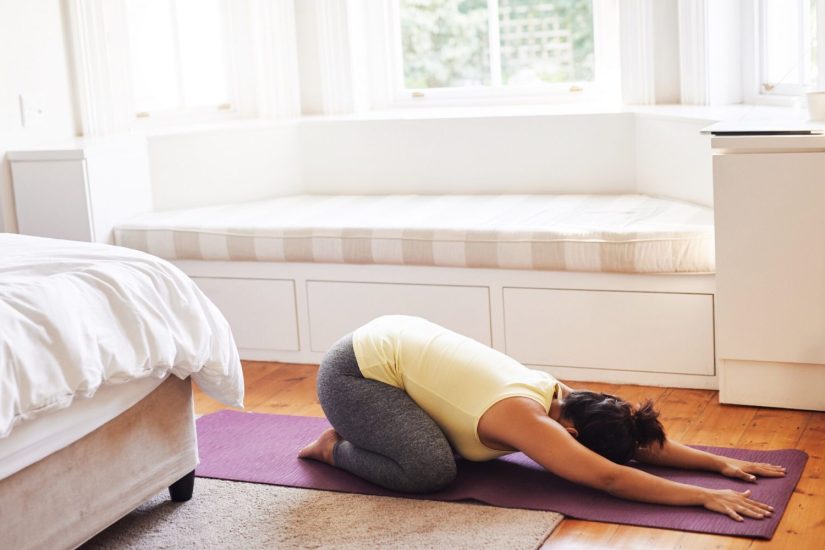
Physical Activity & Taking Care of Your Body

What I’m talking about today, though, is for you to think about self-care in the context of taking care of your body.

Right now, take a moment and ask yourself, “How do I take care of my body?”

Make a list. 

Does moving your body get on that list?

If you are like most Latinas, even if you know that moving that cuerpazo of yours is key to self-care, you probably don’t do it. No tienes tiempo, ni ganas. But because we want you healthy and poderosa, we want you to stop and think about taking care of your body as a vitally important part of being a healthy Super Mujer!

Here are some research-based facts to consider:

  • The U.S. Department of Health and Human Services recommends that adults ages 18 to 64 get 150 minutes of moderate activity per week. That’s about 30 minutes a day for 5 days.
  • Only 23% of all American adults meet these guidelines.
  • By some estimates, only 9% of Latinas meet these guidelines.
  • Almost half of Latinas in the U.S. report never engaging in any leisure time physical activity.

Here’s the good news: Research shows that Latinas who know others who exercise are much more likely to exercise themselves. ¡Así que dale gas, Mujer! And start hanging out with those ladies who go for walks, or Zumba, or to the gym, or dance in front of the mirror when no one is watching!

Move for 30 Minutes a Day

If you are using our Healthy Lifestyle Checklist, you will see that “Move for 30 minutes” is right there on the list for you to check off every day. 

Move for 30 minutes a day. It is one of the healthiest habits you can practice. And it doesn’t have to be hard. Here are some simple ideas:

  • Break it up in 10-minute chunks. My comadre Mary with diabetes goes for 10 minutes after each meal. This helps lower her blood sugar and makes her feel great.
  • Go for two 15-minute walks, like I do with my dog. One in the morning, one in the afternoon. Remember, it doesn’t have to be all at once.
  • Call your comadre and go for a walk n’ talk! Come on, you know you want to. Walking and talking with your comadre is good for the body and the soul!
  • Find a physical activity that gives you joy and do it for 30 minutes every day!
  • Anímate and go to Zumba! Dancing to Latin tunes is so much fun! I haven’t made it the full hour yet, but so what? I feel great when I go and the music is great! 
  • Get a bike! Go for a bike ride. It’s the closest thing to flying!
  • Take a yoga class. It doesn’t have to be from a fancy studio. Check out the local YMCA or rec center. There are lots of on-line resources for yoga too. Try one!
  • Dance to the music in your own living room. Dance with your kids! 
  • Clean the house! Do it for 15 minutes at a time. Mopping is good exercise and so is vacuuming.
  • If you sit in front of a compu all day, get up every hour and walk for 5 minutes.
  • Take the steps instead of the elevator. Park your car further away from the store so you can add a few steps.

The Benefits of Physical Activity

Research proves that the benefits of physical activity are great:

  •       Prevent chronic diseases such as heart disease, cancer, and stroke (the three leading health-related causes of death)
  •       Help manage your weight
  •       Make your muscles stronger
  •       Improves your mood
  •       Promote strong bones, muscles, and joints
  •       Condition heart and lungs
  •       Build overall strength and endurance
  •       Improve sleep
  •       Lower your chances of depression
  •       Get more energy
  •       Build your self-esteem
  •       Relieve your stress
  •       Increase your chances of living longer

Sources:  Centers for Disease Control, U.S. Department of Health and Human Services

¡Hola, Sabrosa!, Edición No. 8: Healthy Habits, English, Healthy Body, Healthy Mexican Food

Healthy Habits & Self-Monitoring: A Powerful Tool for Change

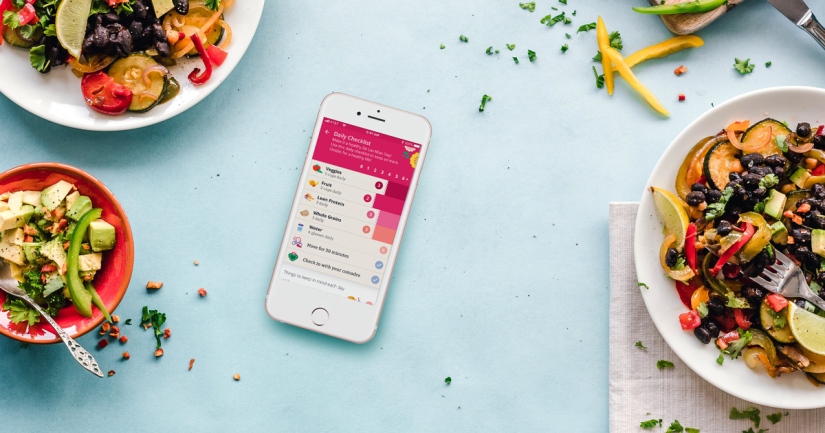
Create healthy habits with our Healthy Lifestyle Checklist

Whether you’re trying to get to a healthier weight or just eat healthier, one of the most powerful tools you can use is self-monitoring. Self-monitoring is simply paying attention to what you’re doing and keeping track of it. You can use self-monitoring to improve your eating habits, track your physical activity, become more aware of your moods – you can even track how you’re spending your money. Self-monitoring gives you power.

At De Las Mías we like to say, ¡Saber es poder! Knowledge is power.

If you are trying to make healthy changes, self-monitoring puts you in the driver’s seat. 

The De Las Mías app offers you two great self-monitoring tools:

  •       The Healthy Habits Checklist
  •       Activity Tracker

The Healthy Habits Checklist

Find this quick and easy-to-use tool on the De Las Mías app! It’s there to remind you of the healthy habits you need to lead a healthier life. Use it daily to keep up with your healthy lifestyle goals. The checklist will help you stay on track: Eat more veggies! Drink more water! Call your comadre! Cut down on sugar! When you use the checklist you build healthy habits.

Do it for 3 days straight. See what happens. Then do it for 5. Then do it again until it sticks. 

The Healthy Habits Checklist is a great self-monitoring tool. The healthy habits on the checklist are proven to improve your health. Get into the habit of using the checklist every day. And then one day, ¡Boinas! You are in the habit of being healthy.

Start doing it today. ¡Te va encantar! ¡You’re gonna love it!

The checklist includes all the important healthy habit goals you need to lead a healthier life, but there are 3 we would like you to start with:

  1.     Eat more vegetables
  2.     Eat more fruit
  3.     Get more exercise

First, let’s talk about healthy habits and how to eat more fruits and veggies. Next, we’ll talk about how to build a healthy habit of moving your body every day.

Let’s Get Started with the Veggie Habit!  

The very first 2 healthy habits we want you to build is to eat your fruits and veggies. According to the CDC (Centers for Disease Control), only one in 10 adults in the U.S. get the recommended amount of fruits and vegetables. Eating your daily fruits and veggies can help reduce the risk of many chronic diseases such as obesity, heart disease, type 2 diabetes, and some cancers.

To jump start your healthy habit of eating more fruits and veggies, our certified nutritionist, la mera Malena Perdomo, came up with daily menus you can try from our recipes. If you choose your meals from the many delicious De Las Mías recipes, you’ll be well on your way to building healthy habits and becoming a Healthy Habit Super Mujer!    

At De Las Mías, we are taking a page from the latest research that shows that you don’t have to count every calorie to get to a healthier weight. You can get to a healthier weight by building healthy habits over time. This is a more balanced way of living and one that you can keep up over your whole life. We’re not losing 30 pounds by Christmas here, Comadre. We’re working on a healthy lifestyle you can keep up ¡Por Vida! (And no, you don’t have to give up tamales.)

So Malena, our nutritionist, works with hundreds of women all over the country in her own practice as well as helping De Las Mías. She tells us, “Many of the women I work with want a simple approach to eating healthier. I help them by giving them a menu to follow for the week.”

Tres Días of De Las Mías: Three-Day Meal Plan

So her is a 3-day De Las Mías  plan that she prepared for you. All of these recipes can be found on the De Las Mías app or website.  We call it, Tres Días of De Las Mías

Here’s how it works:

  1. Review the recipes , check your pantry for ingredients you may already have, and go shopping for the rest.
  2. Try the plan for 3 days and start checking off those healthy habits.
  3. Let us know how it goes.

Remember this: De Las Mías is evidence-based! That means that all our Mexican, Southwestern and New Mexican recipes align with the highest standards set by the USDA as heart healthy and good for you! Our recipes are developed by our Test Kitchen Chef, Lori, in Saguarita, Arizona and then Malena analyzes them in her kitchen in Denver, Colorado. Our recetas are tried, tested and approved by Latinas just like you! 

¡Buen Provecho! 

Day 1 – Tres Días of De Las Mías

Watermelon spinach salad

Breakfast: Spinach Scramble with Queso fresco (140cals)  – Check off 1 serving of veggies!

Lunch: Watermelon and Almond Salad (130cals) and Enfrijoladas de Pollo* (400cals) Check off 1 serving of fruit and 1 serving of veggies!

Dinner: Tuna Tacos (330 cals) and Nopalitos Salsa (1cup 40cals) – Check off 1 serving of veggies!

Snack: Add one fruit, like an apple, orange or banana – Check off 1 more serving of fruit!

¡Eso! You just checked your 3 veggies and 2 fruits for the day! (All this for under 1200 calories – not that you’re counting!)

Day 2 – Tres Días of De Las Mías

Spicy cauliflower

Breakfast: Brunch Quesadilla (250cals)

Lunch:  Turkey Taco Salad* (320 cals) – Check off 2 servings of veggies!

Dinner:  Spicy Cauliflower (60cals), Roasted chicken* (190 cals), and Lori’s Quinoa Jalapeño Salad* (220cals) – Check off 2 serving of veggies!

Snack: Add a cup of chopped fruit like melon, pineapple, and strawberries . Have an orange, apple or banana. – Check off 2 servings of fruit! (Note: Fruit is better with – ¡limón y chilito!)

¡Eso! You just checked 4 servings of veggies and 2 fruits for the day! (Total calories for the day: 1,040. Pero lo más importante is you are building your healthy habits!)

Day 3 – Tres Días of De Las Mías

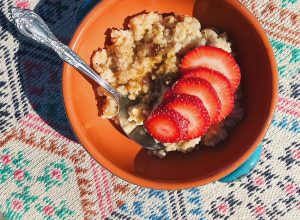
Mexican oatmeal with strawberries

Breakfast: Old Fashioned Mexican Oatmeal* (90cals) and Mango Banana Smoothie* (180 cals) – Check off 1 serving of fruit!

Lunch: Shrimp and Veggie Taquitos (230cals) with Pico de Gallo Salsa (1/2 recipe: 55cals) – Check off 2 servings of veggies!

Dinner: Poblano Chicken Soup (140 cals)  Arroz Verde* (150 cals) – Check off 2 servings of veggies!

Snack: Add your two fruits and check them off! 

¡Eso! You just checked 4 servings of veggies and 3 fruits for the day! (Total calories for the day: 845.

*Recipes only available on the De Las Mías app. Download it today! Available on Google Play and App Store

Note: For these three days, we are just counting veggies and fruits, but notice you are eating whole grains and lean protein too! ¡Eso! You are well on your way to becoming a Healthy Habits Super Mujer!

And we kept the calorie count low on purpose to encourage you to add some healthy snacks, such as your 2 frutas al día, a handful of almonds with a crispy apple, some hummus and veggies, a quick licuado or gazpacho in the afternoon slump.

Healthy Habits Recap

So just to recap: Here you have 3 full days of healthy eating that honors your culture and your buena salud! Get into the habit of eating your 3 veggies and 2 fruits a day and get into the habit of using the Healthy Habit Checklist. And soon you will be a Healthy Habit Super Star! 

This is the way you create a habit:

  1.     Find something you like, for example, our delicious ways to eat more fruits and veggies.
  2.     Do it. Do it again. And repeat until it sticks.
  3.     Use the Healthy Habit Checklist to see how you’re doing and to nudge you to keep doing it! (Self-monitor!)
  4.     Enjoy those ¡Esos! And share them!
  5.     When you get through to the other side of Tres Días of De Las Mías, get yourself a reward! Flowers! A romp through Instagram or Pinterest! A new nail polish. You get the picture.
  6.     Encourage your amigas, comadres, hermanas and even your vatos to join you in your healthy habit quest!

See our 9 Steps Healthy Eating Plan for more ideas on how to embark on a healthier life.

¡Unidas for a Healthy Life!


¡Hola, Guapa!, Edición No. 7: Change, English, Healthy Body, Healthy Comadres

How to Manage Stress to Prevent Emotional Distress

self-care

How is stress affecting your life? Chances are, if you’re reading this blog, you’re concerned about how stress is affecting your life. Long term stress is not good for us, nor for our families and loved ones.  

We recently posted a blog on Cortisol and Toxic Stress and how this hormone, now called the stress hormone, can affect your weight and even your relationship with food. (Cravings, anyone?)

So although we started our conversation about stress, I want to go back  to it, to continue to shine some light on it. In this article, we take  take a deeper dive into how stress can turn into distress, and how we might challenge ourselves to “cambiar el chip,” and take better care of ourselves.

What is Stress? A simple definition of stress is that it is our body’s reaction to change. All of us have stress; it is a universal human condition. But what about when stress turns into distress? And what about when being in distress is your new normal?  Do you feel irritable and tense a lot of the time? Do you have trouble sleeping at night or do you feel like you sleep too much? Do you feel like you are in a constant state of “nervous?” Does this sound like you? You might be experiencing what psychologists call “emotional distress.”   

In their excellent book on change, Changing for Good, A Revolutionary Program for Overcoming Bad Habits and Moving Your Life Positively Forward, Prochaska and his colleagues, Drs. Norcross and DiClemente, talk about emotional distress as the “fever of mental health,” and when I read it being described in that manner, it made perfect sense to me.  

I remember my tías talking about their friends or relatives who were going through hard times…“Pobre, Gloria, she has suffered so much.” They would worry that Tía Gloria could get sick from suffering so much. Often, you would hear them say things like, “Le puede hacer daño al corazón.” (Fear that her suffering could harm her heart.)  And those of us in the younger generation would roll our eyes, at what we perceived to be an Old Mexican Wives’ Tales. But now research is telling us exactly what our elders told us, and that is that long-term stress, AKA suffering, can make us physically and/or mentally sick.

Latinas are used to aguantar, putting up with unpleasant life events just to keep on keeping on. We are experts at putting a positive spin on things. Often, we are the rock of the family and rocks are strong and sometimes indestructible. But as resilient as we are, it is important to open our eyes and take a good look at what is really going on so we can manage our stress and prevent it from becoming distress. Call it long term stress, toxic stress, distress or sufrimeiento. Whatever you call it, this kind of emotional turmoil can lead to more serious problems such as anxiety and depression.  

We come from a culture that denies a lot of things when things go wrong. We pretend that everything is okay when it’s not. Nos hacemos de la vista gorda. (Vista gorda doesn’t mean your vision is fat. It’s a colorful expression that means to “to turn a blind eye.”)

We go into denial. And sometimes, Comadres, we need a little garden variety denial to get us through the day. But today, I just want to nudge you a little bit to get you to pay attention to your stress levels.

When stress turns into distress, it’s bound to wear you out and wear you down. When this happens, we cope in the best ways we can, but it’s not always pretty, nor healthy.  

I don’t know about you, but when I get stressed to my limit, I want cake. (Preferably chocolate cake. There is a great bakery in Santa Fe – The Chocolate Maven – and when I get stressed, my car knows the way. When I’m in Portland, I ride my bike to the bakery and that always feels more righteous.) And look, who can deny that once-in-a-while, cuando ya no aguantas, indulging in a piece of cake, ain’t going to kill you.  

But the important point here is that cake is a mean mother. She can turn on you if you don’t watch it. One minute she’s telling you, “There, there,” and the next, she’s telling you “You’re a bad girl and deserve to be punished.”

Eating cake to manage distress is not “sustainable.” Over time, eating cake, or taking a few extra shots of tequila, mezcal or even a few more of those femmy margaritas, to cope with stress, is going to make you feel worse.

I tell you this because I know.

So, in keeping with the topic of self-acceptance, I want to gently remind you that the first step in managing your stress in a healthy way is to accept what it is. Shine a little light on it and accept it without judgement. Accept that sometimes when you are in distress, you may do things that are just plain unhealthy. Take your next step from a place of self-acceptance, without judgement and move on.

“Paso por paso,” is one of our favorite dichos at De Las Mías, and it works very well with managing your stress.

So, in the spirit of shining a gentle light on distress, see if you can’t come to terms with what is really going on. We want you awake and aware so you can take better care.

Moving forward, recognize the tell-tale signs of stress from the National Institute of Mental Health:

  • Trouble sleeping
  • Drinking more alcohol
  • Overeating
  • Feeling moody or cranky
  • Having low energy
  • Feeling down in the dumps


Use these tell-tale signs of stress to take extra care of yourself. Here are 9 things that mental health experts recommend for taking better care of yourself in times of stress:

  1. Get regular exercise. A simple 30-minute walk will do wonders. It can lift your spirits and often change your mood.  
  2. Eat well. When you are in a state of emotional distress, the last thing you need is a crazy diet. Nurture your body with good healthy food and cut back on sugars and junk food. (Start using our Healthy Lifestyle Checklist available on our App!)
  3. Have fun. This seems obvious, but you would be surprised how many of us just stop having fun when we’re stressed out. Make a list of all the things you do for fun and do as much as you can to cheer yourself up.
  4. Practice deep relaxation and/or meditation. Be mindful of the tension you hold in your body and letigo.
  5. Protect yourself from people who criticize you or put you down. It’s okay to avoid mean people. You know who they are.
  6. Don’t believe everything you think. When we’re beyond stressed, distress can impair your thinking. Distress es muy mentiroso…it can make you think things that are just not true. Be especially aware of self-put downs or mean things you tell yourself. Don’t believe it.
  7. Drink water. As you drink it, become aware that you are doing a loving thing for yourself.
  8. Ask for support. Reach out to your friends, comadres and sisters and share your feelings.
  9. Reward yourself when you do any of these 9 things. And then reward yourself for rewarding yourself. ¡Eso!

Sometimes, long-term stress turns into emotional distress.

Signs of Emotional Distress

When long-term stress turns into emotional distress, we need to watch for signs of depression.  

Recognize the signs of depression: If you have 2-3 of these signs over a period of 2 weeks or more, it’s time to get some help.  Talk to your doctor, clergy or mental health counselor if you experience 2-3 of these signs for more than two weeks.

  • Feeling sad
  • Trouble sleeping
  • Sleeping too much
  • Feeling like nothing is fun or enjoyable
  • Feeling low energy
  • Not feeling hungry
  • Overeating
  • Trouble concentrating
  • Feeling hopeless
  • Feeling like life is not worth living

Emotional stress can sometimes turn into anxiety.  

Recognize the signs of anxiety. Here are some signs of anxiety that you can watch for.  Talk to your doctor, clergy or mental health counselor if you experience 2-3 of these signs for more than two weeks.

  • Constant or on-going worrying
  • Feeling like you can’t relax
  • Feeling irritable, moody, jumpy, or nerviosa
  • Trouble sleeping
  • Fears: like fear of the dark, fear of being alone, fear of crowds
  • Heart symptoms like fast heartbeat, chest pains, tightness of chest

If you ever feel like you want to hurt yourself or have suicidal thoughts, please call this number: Call 1-800-273-8255. National Suicide Prevention Lifeline. Available 24 hours every day.

Spanish: 1-888-628-9454


Sources:

Prochaska, Norcross, and DiClemente. Changing for Good, A Revolutionary Program for Overcoming Bad Habits and Moving Your Life Positively Forward.  Quill – HarperCollins. 2002.

The National Institute of Mental Health: http://www.nimh.nih.gov. 5 Things You Should Know About Stress. Retrieved 2/10/2019.

Kroenke, K., Spitzer, R., & Williams, J. (2001). The PHQ-9 validity of a brief depression severity measure. J GEN INTERN MED, 16, 606-613.

Maier, et. al. The Hamilton Anxiety Scale: reliability, validity and sensitivity to change in anxiety and depressive disorders. Journal of Affective Disorders. Volume 14, Issue 1, January–February 1988, Pages 61-68

¡Hola, Guapa!, Edición No. 7: Change, English, Healthy Body, Healthy Comadres

Self-Acceptance

Can We Talk About Self Acceptance? Look, we know the majority of us Latinas are overweight. And we know that being overweight and/or obese puts us at higher risk of prediabetes and diabetes. What you may not know is that it also puts us at risk for heart disease and even some cancers. Not to mention self-judgement, self-loathing and yo-yo dieting.

But how much good has it done for us to hate ourselves and go on stupid diets that don’t work? NADA.

¡YA! Enough. At De Las Mías we want you to do something different. It’s time to cambiar el chip. We want you to strive for living a healthier and more joyful life. By making small, healthy changes over time, we are sure you will be happier, healthier and much better off. And rather than beating yourself up and taking extreme measures that don’t work, we encourage you to take this approach and look at your health as a journey.

And believe us, it is a journey. Paso a paso, we will get to our destination:

Una vida más saludable that affirms our authentic selves.

So if you’re just joining us or if you’re already well on your way to a healthier, happier life, we challenge you to incorporate a novel concept into your journey…this novel concept is called Self-Acceptance.

Self- Acceptance 

Self-Acceptance means that you embrace yourself as you are now, without any judgements or criticism. Accept the good with the not so good; the good, the bad and the ugly como el Clint Eastwood.

Not so easy, for us criticonas, right? And if you are a perfectionist, may la virgencita have mercy on you, because self-acceptance is a very hard concept for those of us who criticize too much.

La neta, the truth is, that many of us are just not that kind to ourselves. How many times have you called yourself “tonta”? Be honest. How many times have you heard that little voice inside your head call you dumb, mensa, awkward, clumsy or fat? We are used to living in this good girl, bad girl world. Are you being good when you eat a salad and bad when you eat a donut? Can we just stop that please? Can we separate what we do from who we are?

Accept Yourself as You Are 

We want to challenge you to accept yourself as you are, without judgement, insults or dirty looks in the mirror. No exceptions.  

Here’s an old dicho from Pedro Infante, Mexican film icon and singer, that you may have heard. It was part of a song he sang to impress the ladies: “Soy quien soy y no me parezco a nadie.” It’s a bit like Popeye’s “I yam what I yam.” It means you are you and you aren’t like anyone else. And when you say that, “Soy quien soy,” you claim your uniqueness and your self-acceptance. ¡Eres, única! Embrace it and yourself as you are now, ¡Y ya!

Psychologists and human behavior experts, such as Dr. Pillay from Harvard University Medical School, are discovering the importance of self-acceptance as a foundation to general well-being and good mental health. New research is starting to prove that in order to make healthy changes, it is important that you start with the good foundation of self-acceptance.

Self-Acceptance Doesn’t Mean You Can’t Change

There is an important distinction that I want to make here. Practicing self-acceptance does not mean that you don’t want to change something or make improvements in how you live your life. But self-acceptance is a healthy foundation from which you can grow and change.  

To embark on your odyssey to self-acceptance, I’m offering some tips from positive psychology that you can take on your journey. Try this:

Learn to separate what you do from what you are. Those of you who are moms know this best. When you’re hijita does something bad, it doesn’t mean she’s bad. Making a mistake doesn’t make her a mistake. You just need to help her do better next time. Channel your own best mom and give yourself a break.  

Use Self-Acceptance to Get Yourself Out of Denial.

This is an important point for those of us who have a problem with overeating or eating to satisfy emotional hunger. In an earlier blog, I shared with you a trick that I learned to assess if I was emotionally hungry or physically hungry and I want to share it with you again. If I feel hungry and reach for a healthy snack like a handful of almonds, a yogurt or a pepino con chilito, and I feel satisfied, I know that I was physically hungry. If after my healthy snack, I still feel hungry, it’s a good bet that I am eating to feed an emotional hunger. When you make this discovery, just take it in without judgement. This is good information, a data point. Once you accept that you eat for emotional reasons, you can look for ways to change that habit. If you never accept this as something you do, you will keep repeating it. Self-acceptance is fueled by self-awareness. Awareness is always a good place to start.

Practice Mindfulness

You hear a lot about mindfulness these days. You can use mindfulness in all areas of your life. Basically, mindfulness is paying attention. It is becoming aware of yourself. It is paying attention to what you eat, how you listen, how you don’t listen, and how present you are in your own life.  

One mindfulness practice is to take a few minutes and just be with yourself. Simply observe how you feel and how your body feels, without judgement. Practice this kind of presence of mind and body without self-criticism or put downs. With time, you will start to feel a stronger connection to yourself.   

There is mounting evidence that self-acceptance can lead us to self-care, stronger self-esteem and better health. And at De Las Mías we are all about THAT!

Can you commit to self-care and showing yourself some Amor Propio?   

It can start with you doing nice things for yourself, like getting a massage, eating healthy food, drinking more water, going for a walk, meditating, asserting yourself, speaking up,  saying no when you mean no, and yes when you mean yes.

There are hundreds of ways to show ourselves acceptance and self-love and I want to challenge you to start practicing Amor Propio.

ana-oaxsaca

A Personal Story of Self-Love: Amor Propio

I want to share a personal part of my story with the hope that it may speak to you: I was born fat. I weighed 12 pounds 6 ounces when I was born in El Hospital Del Socorro in Nogales, Sonora, Mexico. I grew up fat until I got amoebas. Then, I was skinny for about a month until my mom and tías figured it out. They put on some kind of tratamiento and I got fat again. In school, because I was fat and tall, my friends used to call me Giant. My cousins called me Gorda; the ones who liked me called me Gordis. My mom, who thought being thin was next to godliness, had me on a diet until I was 18.  She was an early adopter of the Atkins Diet, and she had an eating disorder. Her favorite piece of advice was, “Ya no comas pan.” (Don’t eat bread, already.)

Whatever was going on there, let’s just say that bread was not my enemy. With the help of a well-intentioned mother, I grew up with a messed up body image and a list of forbidden foods. Even at 17 years old, weighing 140 pounds and a 5’7” frame, I still felt fat. I still thought that chocolate, tortillas, tamales, and bread were out to get me. At one point, I had a sign on the refrigerator that said, “Oreo cookies are the road to hell.”

It wasn’t until I hit my late 30s and found a therapist that I began to understand that what I needed more than Thin Within, Weight Watchers, Atkins, South Beach, Low Carb, No Carb, Slimfast or even Overeaters Anonymous, was Self-Love. ¡Amor Propio!  That is what I needed and that is what I got, but it only took me 40 years.

So I’m hoping that my combination of disordered eating, messed up body image and a first class education in health education will help you avoid all those trampas and come out of it less beat up than I did.  

So, as you read this, I just want you to pretend that I am your maestra, your madrina, or your loving tía who loves you just the way you are. And this is your homework:

Make a list of things you can do for yourself that show you some Amor Propio.

¡Andale! Share your list with me at ana@delasmias.com and I will send you a surprise!

Just to get you started here’s my list. The things I do for love – self-love that is!

  1. Me compro flores. Each week, I buy myself flowers. En el Safeway, they cost about 6 or 7 bucks. Carnations last the longest and they smell good and come in all colors.
  2. In the summer, I grow my own dahlias, hydrangeas, roses and zinnias. Se siente bien suave, to put fresh flowers, that you grew yourself, into a pretty vase.  
  3. I ride my bici every chance I get. I love myself on my bike, girl! I ride, rain or shine. No rain shower keeps me from my bici. And when I ride, I give that little girl, the one that used to be called Gorda a run for her money. I sing to myself while I ride. I really do. It’s super fun. (This little light of mine…)
  4. I tell my legs how much I love them! I got some pretty bitchin legs. I’ll tell you what! Riding 5 to 7 miles a day on a bike will do that to a Super Mujer.
  5. I eat vegetables, Sisters! Show your body some serious love by eating fruits and veggies. Learn how to make yourself a Jugo Verde and love yourself before you start your day.
  6. I drink a boat load of water. Yeah, such a simple act of self-love. Take a page from our Creative Director, Shannon, and by yourself a beautiful water bottle and fill it with Amor Propio infused H2O. Make it count = 6 glasses.
  7. No como comida chatarra. I don’t put junk food in my body…unless I’m on a road trip (Fanta and Cheetos!) But that is so rare, Poquito Porque Es Bendito!  
  8. I look for people who laugh at my jokes. I call my seester every day and we make each other laugh. Miriam makes me laugh and Sati just cracks me up. Liz, being from Nogales, gets me like no one else does.
  9. I make myself reach out! Sometimes I’m so busy pretending that I’m la mera mera fregona that I can take it in the chin like the machita that I am, and I go it alone. It don’t work. Call your comadre and tell her what’s going on in that heart of yours. Make sure she’s a kindred spirit so you don’t get hurt.
  10. I treasure my sleep and don’t deprive my body of its magic.

So what do you do for self-love?

Make a list. Share it with me at ana@delasmias.com and I’ll send you a cariñito!

Sources:

Pillay, Srini, MD. Greater self-acceptance improves emotional well-being. https://www.health.harvard.edu/blog/greater-self-acceptance-improves-emotional-well-201605169546

University of Hertfordshire. “Self-acceptance could be the key to a happier life, yet it’s the happy habit many people practice the least.” ScienceDaily. ScienceDaily, 7 March 2014. <www.sciencedaily.com/releases/2014/03/140307111016.htm>.

¡Hola, Sabrosa!, Edición No. 7: Change, English, Healthy Body, Healthy Mexican Food

Meatless Monday

Meatless Monday – A Fun Way to Start Eating More Veggies

One of my healthy living goals for the new year is to cut down on meat, and eat more more fruits and vegetables.  

A fun way to do this is to start a Meatless Monday tradition. So we agreed that we could try new recipes, and start the week off with a slightly healthier approach. Also, in these times of climate change, I am constantly worried about our poor little planet! Eating less meat is good for our bodies and good for the planet – a win-win!  

I was remembering my life in Nogales and how we had Meatless Mondays at my Nana’s house “across the line,” on the Mexican side of border. And then I realized that it wasn’t just Meatless Monday, but also Meatless Tuesday and Meatless Wednesday. And then, wait! Hold on. We pretty much went meatless every day except for maybe Carne Asada Sunday!  

The reason wasn’t that we were trying to save the planet, or lower our cholesterol. The reason was that my Nana and my aunts and uncles who lived in that old adobe house on the hill, didn’t have the money to buy meat for a giant family.

We ate frijoles de la olla, frijoles refritos, sopa de frijoles, enfrijoladas, burritos de frijoles, frijoles con chorizo, tostadas with you guessed it, frijoles, and even a special trick I learned: Cave out a bolillo roll and fill it with frijoles and queso fresco! YUM! This all paired really well with my Nana’s killer salsa de chile verde. And ¿sabes qué? I never once felt deprived. I felt loved and satisfied and nurtured.

When we were on the Mexican side of the border, we were poor and we had a super healthy diet. We never ate large portions because there weren’t that many portions to go around. But we never went hungry either, so we were lucky.

You’ve heard it here before and we will say it again: the traditional Mexican diet is a SUPER healthy diet! Our Mexican diet was pretty much dominated by protein from beans, eggs and queso fresco, and bolstered by corn, which is the grain of the gods. (No fooling.) Sure, we ate meat with our meals, but they weren’t dominated by large portions of it. If we had meat, it was in very moderate to small amounts, and mostly for taste.

But here we are now, trying to adopt a healthier way of living. And all we Mexicans have to do is look back to the way of our Nanas and Tatas!

In doing research about Meatless Mondays, I found out that Meatless Monday started as a movement by our colegas at the Public Health School at Johns Hopkins University, back in 2003. Through research, they discovered that Monday was the ideal day to try to recover from the overindulgence of weekends. (Overeating, disrupted sleep patterns and possibly even drinking too much.)  

Some of this research showed that people were motivated by making a small but significant change at the start of the work week. That is where the idea of Meatless Monday came from. As more and more people adopted the idea of not eating meat on Mondays, they became healthier, poco a poco, over time. Here is more evidence that small changes over time are the ones that last. It wasn’t a drastic thing, but just one day a week. The idea is that we could become just a little healthier if we took this small step. We would become healthier and the planet would benefit too.  


So Meatless Monday took off and other countries and organizations started getting on board. Australia tried it. Paul McCartney promoted it. Even beef-consuming Argentina got into the act in 2017 by declaring Vegan Mondays!

If you want to learn more about the history of Meatless Mondays, see the Wikipedia article. It has a fascinating amount of information that will surely inspire you to try it!

So at De Las Mías we want to encourage you to give Meatless Monday a try. Here’s another way to eat more veggies and fruits for your health and help Mother Earth carry the load.

Here are some of the benefits of Meatless Mondays:

  • Lower your cholesterol and therefore, your risk of heart attack and stroke.
  • Help you get to a healthier weight.
  • Help lower your risk of high blood pressure.
  • Increase your intake of fiber and its health benefits.
  • Take a little stress off the planet (plant-based foods take less energy).
  • Use less water to grow food (plant-based foods take less water than animal-based food).
  • Plant-based foods pollute less than cows.  

Try some meatless dishes from De Las Mías:

And we’re curious…

  • What’s your favorite meatless dish?  
  • How would your family feel about starting a Meatless Monday tradition at your house? Would they be on board?
  • What is the biggest barrier to going meatless on Mondays?

Sources:

https://en.wikipedia.org/wiki/Meatless_Monday

https://www.economist.com/the-economist-explains/2017/10/19/argentinas-vegan-mondays

¡Hola, Sabrosa!, Edición No. 6: Healthy Eating, Edición No. 8: Healthy Habits, English, Healthy Mexican Food

The Taquito Diet™


The Taquito Diet

At De Las Mías we don’t normally use the word – ‘diet.’ Diets have gotten to be trite and boring, and we don’t like them very much. We know that if you go on a diet, the chances of you succeeding are slim. (No pun intended.)  

Therefore, De Las Mías is not a diet club. We are a healthy lifestyle community. And we are here to help you take steps to be your healthiest self! We focus on the pleasure of eating and cooking good food. We don’t believe in deprivation, as evidenced by our “Poquito de Todo” philosophy. But because we are a healthy lifestyle community and we want to meet your needs, we do pay attention and many of you want to lose weight and want to get healthier and stronger.  

We’re with you! We support you on  your healthy lifestyle journey, but we don’t want you to go on a diet.

Proud Latinas

As you get to know De Las Mías better, you also know that we are proud of being Latinas, and we love nuestra comida. You will find De Las Mías recipes that are Mexican, New Mexican, and Southwestern. We are proud Latinas, Mexicanas and Chicanas and we want you to be proud too! We come from a rich Indo-Hispano tradition and we have a passion for our indigenous roots and foods!

As we grow and add more recipes and ideas on how to live healthier and more joyful lives, we want to add more ways that you can connect with your roots through your enjoyment of delicious, healthy food. And since most Latinas are both indigenous and Spanish, we want to fold in our love for the Mediterranean way of eating and enjoying food. So we are providing you with two ‘undiets’: The Mediterranean (Un)Diet and The Taquito (Un)Diet!

The Taquito (Un)Diet!

I am so proud of being Mexican! We are blessed with one of the most diverse, healthy and delicious foods in the world! Our Indigenous mothers and Spanish fathers, through many trials and tribulations combined to make us and our food, Mestizas! And what a beautiful combination that ended up to be. If you feel like geeking out on the origin of the taco, check out the Smithsonian: Where did the Taco Come From?

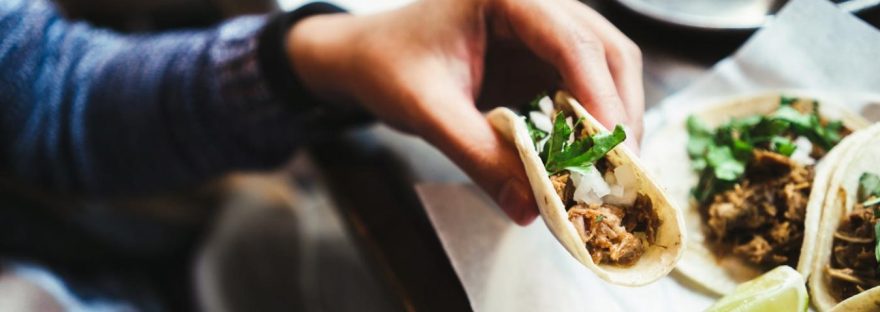
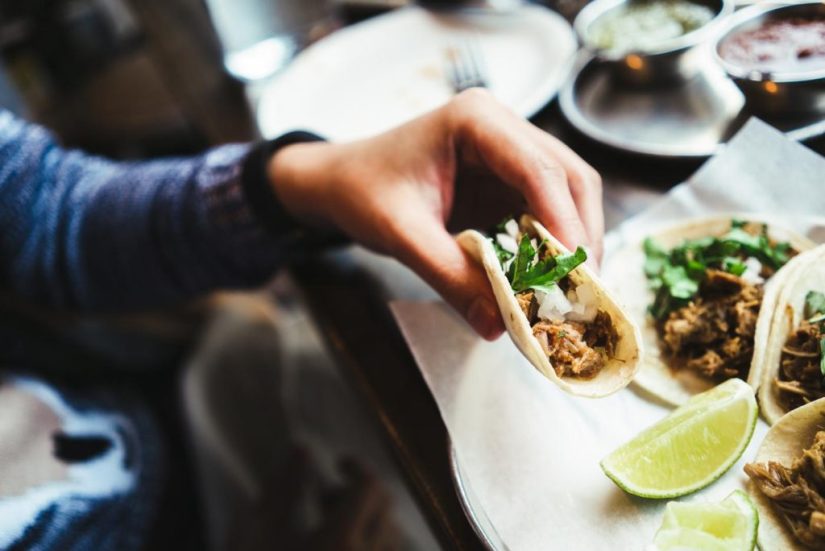
Take the humble taco, a portable bundle of deliciousness and health! It’s the perfect package of whole grains, lean protein, vegetables and even sometimes fruit!

You’ve heard of the grapefruit diet, the celery diet, the paleo diet, the Atkins diet, the blah-blah-blah diet! Now let me tell you about the Taquito Diet™, Baby! It’s a modular, delicious, nutritious and soul feeding pathway to health! You saw it here first!

Here is the skinny on the Taquito Diet:

1. You can make a healthy taco!

2. You can lose weight and enjoy your soul food while eating tacos.

3. You can mix and match, get creative and have fun while achieving a healthy lifestyle for you and your familia!

The taco could change your life! ¡Creélo! Believe, Comdres!

Here’s how it works:

1. Start with 3 corn tortillas.

We’re all about eating more whole grains and these thousand year old tortillas are a great low calorie, whole-grain, flavor-packed vehicle for all things deliciosa!

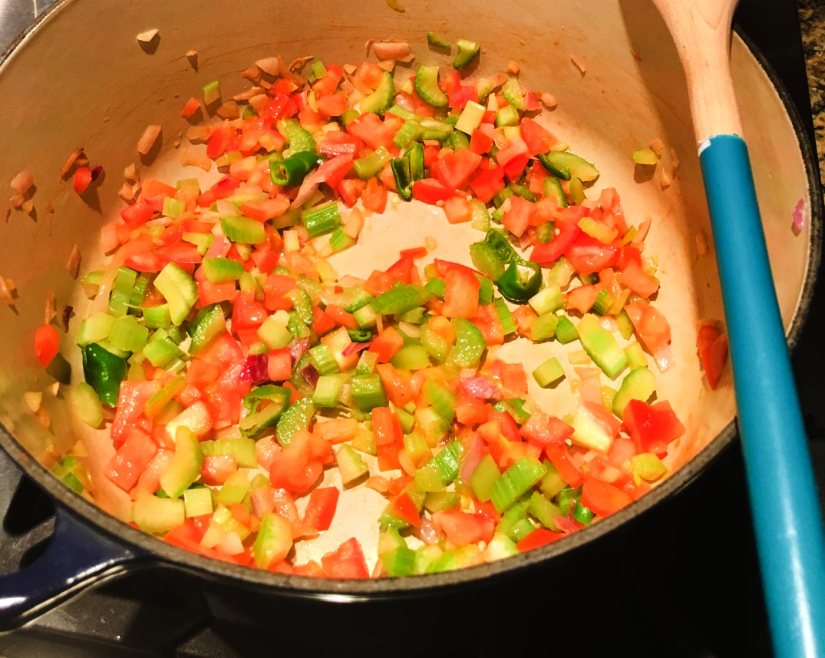
2. Make a sassy sofrito.

One of the very first things that my mother taught me about cooking is to always start with a sofrito. She said that my food would always be delicious if I started whatever I was doing with this magic concoction. It seems like every family has their own version of sofrito. My sister always adds a little fresh garlic, carrots and celery. My Ecuadoran consuegra calls it “Refrito,” and hers includes garlic, onion and achiote.

In our family, it meant simply frying up green chile, onion and tomato in a bit of olive oil before adding your meat, your eggs, or your frijoles de la olla. In Spain, sofrito almost always involves garlic and red pepper. So, the takeaway here is that almost all Spanish, Mexican and Latin American cooks use some kind of sofrito.

Hint: this is one place to add a veggie serving to your day.

3. Add a delicious meat or veggie heart!

A roasted chicken is an easy, simple way to fill your taquitos. Sometimes if we haven’t had a chance to cook dinner, I will stop by the market and get one of those rotisserie chickens that are already roasted. I remove the skin and chop it up for taquitos. I always start with the simple green chile, onion and tomato sofrito my mom taught me to make.

Carne asada is always a class taco choice. Or for the vegetarians in your life a delicious spicy cauliflower.


4. Top it off with soul-affirming salsa. ¡Qué viva el chilito!

Salsa is in our blood. Our indigenous ancestors were making salsas before the Spaniards landed. ¿Sabes qué? Mexican salsas originated with the Aztecs. And apparently, the Incas and Mayans were no slackers when it came up to making these tasty concoctions. (Ají, any one?) The base of a good salsa is, el chilito! You cannot have a good salsa without chiles, but the next most common ingredient is el tomate — the tomato.

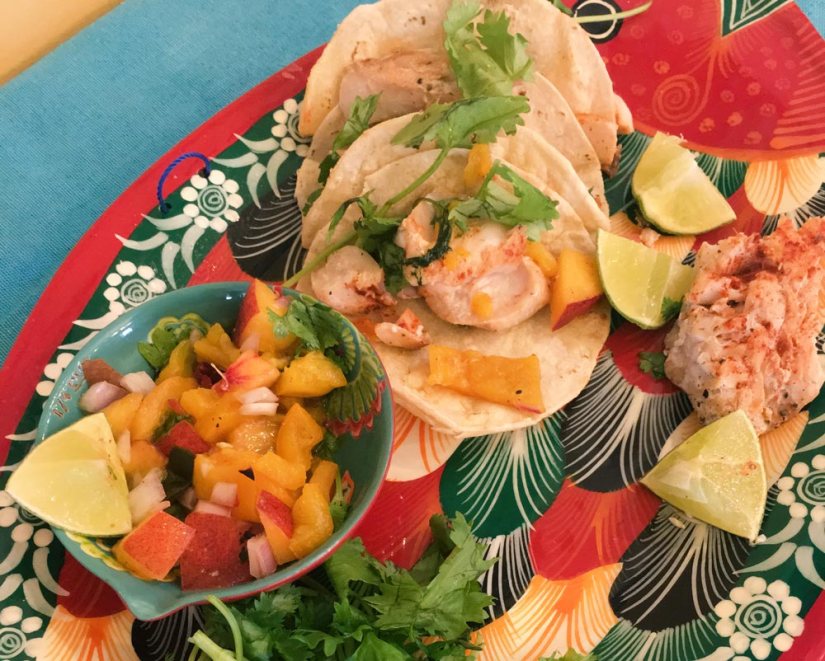
Salsa, of course, has evolved and many other healthy ingredients were added such as cilantro, parsley, epazote and other spices, and lest we forget, the heroic avocado! Today, there are hundreds of different kinds of salsas. We love fruit salsas, like mango, peach and jicama salsa. Salsas can be raw or cooked. My own favorites are raw salsas, like Pico de Gallo with jalapeños or a good Hatch green chile, or even the humble Anaheim! But one thing is for sure, and that is that salsas are healthy foods that you can use in great abundance and feel good about it. Get your veggies here, Comadres!

Here are some of our favorite salsas:

5. Serve with a side of roasted veggies or raja de chile verde.

And just for safe measure another serving a veggies. 😉

Here are 4 Taquito Diet Recipes in our app to start you on your journey to a better taco!

  1.  Tacos de Camaron
  2.  Tacos de Atun
  3.  Pork Taquitos
  4.  Lazy Sari Avocado taquitos

All of that for just about 500 calories! No fooling. ¡Buen provecho, Guapas!

〰️

Check out the De Las Mias app. It’s free and ready for download in the Google Play Store.  Follow us on Facebook and Instagram @delasmiaslife.

¡Hola, Guapa!, ¡Hola, Sabrosa!, Edición No. 6: Healthy Eating, English, Healthy Comadres, Healthy Family

Healthy Eating Wisdom: Eat Like Your Abuelos

  Looking for Healthy Eating Wisdom?  Your Abuelos Might Have the Answer

Have you noticed how many diseases are related to what we eat? High blood pressure, heart disease, diabetes, cancer. And if you’re trying to come up with a healthy eating plan, it is very confusing. Eat this. Dont eat that. Every time you turn around, there is another diet that you have to follow.  It’s enough to make us un poco loca.
 
But lucky for us, there’s some encouraging news. Researchers are finding out some things that many of us already know. Our grandparents and great-grandparents had a healthier lifestyle than we do, and that’s a fact.

Healthy Eating Wisdom from My Grandfather Take my Papa Pepe for instance, my dad’s father, who immigrated from Spain. Wiry little dude walked everywhere! If he weighed 135 pounds, he weighed too much. Swore that the onion he chomped on and the copious amount of garlic that my abuela cooked with kept him young and nimble even when the arthritis caught up with him in his 70s. We have an old cane of his that has a black mark on the inside of the curve of the cane, and that was from jumping on the bus. He used to run up to the bus and hook his cane around the door handle and hoist himself up the bus steps without missing a beat. Three Meals a Day I remember he bragged about his eating habits. “I eat breakfast, I eat lunch, I eat dinner. ¡Y, Ya! The big meal in those days, and still today in Spain and Latin America, was lunch. And that was paired up with a nice nap. La hora de la comida, which is what we called it at home, started with soup, then a second dish mostly consisting of a small portion chicken, fish or meat and veggies. Dessert was usually a cup of flan or fruit, or even 2-3 galletitas, usually Marías. Small portions but with a lot of variety. The soups were basic and traditional like cocido, which is made up of lots of veggies and very little meat. This was my Papa Pepe’s favorite. But there were also the caldillos. Ours were usually made with chopped fresh tomato, garlic, onion and green chile with small bits of lean beef and cubed potatoes. Meat was expensive then, so the meat portions were always small. A chuleta (pork chop) was thin cut and no bigger than the palm of your hand. The side dishes were veggies such as calabacitas, green beans, or a cucumber salad. ¡Un pan! (One piece of bread) Dinner was lighter than lunch. Some leftovers from lunch perhaps, or a lentil stew with carrots and onions, or even a simple bowl of frijoles de la olla. Sometimes we had chorizo con papas, scrambled up with some eggs. This was a bit heavier, but again, the portions were small, so we could enjoy it without excess. ¡Chiquito pero sabroso! (Small but tasty. ) You can eat a great variety of foods when you eat small portions. “¡Es provete, no traguete!” is one of my favorite dichos related to eating. (It translates to: it’s a taste, not a gorge.) So even a traditional chorizo, which has more fat than a regular cut of lean meat, in small amounts, is delicious. Todo en moderación. (Everything in moderation.) Papá Pepe was anti-chuchulucos. Now there’s a word for your dictionary! CHUCHULUCOS. (Mostly refers to the sweet stuff, like candy, churros, pies, pan dulce, cakes, etc.) He never touched the stuff.   So my abuelo ate three meals with no snacks in between; never ate sugar, except maybe in his café con leche, walked everywhere he could, and worked from sun up to sun down. Lived to be 90. But life has changed. Now we supersize our meals. We use food as a stress management tool and snack for entertainment purposes. The crunchier, the fattier, the more addicting, the more we like it. We sit in our cars, sit in front of our desks, plop down in front of some kind of screen for hours every day and weigh much more than our grandparents did. One of the most interesting lectures I ever attended as a health educator was years ago from Dr. David Hayes Bautista, a Professor of Medicine and Director of the Center for the Study of Latino Health and Culture at the School of Medicine at UCLA.  He cautioned that “Assimilation could be hazardous to our health,” and it was all about how Mexican immigrants were healthier when they got here than when they had lived here for a few years. Current research from UCLA also shows that as Mexican immigrants spend more time in this country, their health physical and mental health deteriorates. The basic traditional Mexican diet consists of corn tortillas, beans, fresh vegetables like tomato, avocado, chiles and onions, and some fruit. Traditional Mexican life included walking as a means of transportation and working hard.   Once we gave up walking as a mode of transportation, changed our traditional lifestyles from working on farms and ranches or even subsistent farming like growing our own food and tending to our orchards, gardens and chickens, we also started eating larger portions and more processed foods with lots more fat, sodium and sugar. Modern North American life has not been kind to our health. Along with eating more processed and fast foods, came the convenience and affordability of cars. These changes make our lives easier but also carry unintended consequences. (Para cada solución hay un problema.) We eat more poorly and are less active than our grandparents, and our poor bodies just started slowing down and wearing out. It’s not rocket science, Comadres. But there you have it. There’s an old dicho that you might have heard: “Lo que no mata engorda.” The equivalent of – “If it  doesn’t kill you, it will make you fatter.” Now, a more appropriate dicho for our times  may be, “Lo que te engorda, te puede matar,” – “That which makes you fat may kill you.” Unfortunately, I speak from experience. I just found out that I have prediabetes again. I had been diagnosed with prediabetes many years ago and that is when I started biking every day and cutting back on carbs and fat. I lost the magical 5%-7% of my body weight, and the prediabetes went away. It worked for me for over 10 years. Recently, I gained some weight, and sure enough, I am back in the prediabetes range. Now let me tell you that I haven’t changed my mind about having diabetes. I do not want diabetes, and I am going to do what I can to prevent or delay it.   So, I am going to channel Papá Pepe and start going back to a more traditional way of eating. I’m cutting back on portion sizes and do more walking.   I always thought that I did plenty of exercise. I ride my bike every day, come rain or shine, but I also confess that I’ve been riding to a French Café. So, I’m bailing on the croissant and switching to whole grain toast. When my Viejo takes our giant dog for a walk in the morning, I’m getting up and going with them even if it means going in my PJ’s. (I’m in Portland right now and people shop in their pajamas here, so I’m cool.) I’m using our De Las Mías Healthy Lifestyle Checklist and calling my Comadre, best friend and sister, test kitchen chef, extra-ordinaire, and Silver Sneaker maniac to report in.    No more CHUCHULUCOS for me and that means, not eating those sour ginger candies I get at the corner store! BUMMER! Okay, well maybe just a few on the week end! ¡Poquitos porque son benditos! I’m going to practice what I preach and let you know how it goes. In 6 months, if I lose 5%-7% of my weight, I should be under the Pre-diabetes range again.   For now, I’m going to take it easy, be kind to myself, love my body, treat it well, and make it last. I’m signing off now to take my bici to Petite Provence, to eat my whole grain toast with an egg for protein and to enjoy the fall colors. ¡Hasta la vista!   Sources: Gordon, Dan. Life in America: Hazardous to immigrants’ health? December 01, 2014  Pérez-Escamilla. Acculturation, nutrition, and health disparities in Latinos. American Journal of Clinical Nutrition. 2011;93(suppl):1163S–7S. 2011 American Society for Nutrition  

¡Hola, Guapa!, Edición No. 6: Healthy Eating, English, Healthy Body, Healthy Comadres

Latinas, Cancer and Healthy Lifestyles

Latinas, Cancer and Healthy Lifestyles: What Every Latina Needs to Know

Lately, we’ve been talking about what researchers call the Latino Health Paradox. The mystery of Latino longevity that shows that, a pesar de todo, in spite of all the odds, such as low education, low income, and low access to health care, Latinos still live longer than anyone else in the U.S., and Latinas live longer than anyone else!

That is good news, Comadres!

But even though we live longer than most people in the U.S., we are not protected from obesity, heart disease, diabetes and some cancers. We hear a lot about diabetes in our community, but not that much about cancer, and cancer is a doozy.

Latinas and Cancer is a complex topic, but it’s one we think is important for you and your comunidad to understand. (Hint: Prevention and early detection!)

Latinas and Cancer

According to the American Cancer Society 2018-2020 report, Latinos and Latinas are less likely to be diagnosed with cancer than non-Latino whites overall, but cancer is the leading cause of death among Latinos. (Go figure!)

There are several reasons for this confusing fact. One reason may be that incidence of cancer is just lower among Latinos, which would be very good news, indeed. But another reason might be that Latinos get diagnosed in later stages of cancer when it is too late to cure it. And that is tragic news, Comadres, because many cancers are curable if we catch them early enough.

Another blow to the cancer dilemma among Latinos is that many of us don’t have access to health care. Some simply don’t have the resources to treat cancer when it happens. Many states have cancer early detection programs that are often free or low cost. In some states, there may even be low cost treatment options, but being low income and not having health care is still a huge challenge and one that we need to address. (a discussion for another day).

We have prepared an overview on Latinas and Cancer.   Here are some Healthy Lifestyle steps to take to protect yourself.

Breast Cancer

Breast cancer is lower among Latinas than non-Latinas in the U.S., but breast cancer is still the leading cause of death among Latinas.  

The reason why: breast cancer in Latinas is often found in the advanced stages when it is harder to cure. Latinas don’t get mammograms at the same rate as non-Latina whites. Some of our comadres can’t afford it, but some of them just don’t get mammograms. They’re busy or they’re embarrassed or they just don’t want to deal with it, but they don’t go and that does not end well.

Early detection of breast cancer saves lives.

What to do:

  • If you are 40 to 44, the American Cancer Society recommends that you start talking to your doctor about mammograms.
  • If you are between the ages of 45 and 54, the American Cancer Society recommends a yearly mammogram.
  • If you are over the age of 55, the American Cancer Society recommends a mammogram every two years.
  • All women need to learn how to do self examine our breasts. Your health care provider can teach you how. Just ask!
  • If you don’t have insurance, there are breast cancer early detection programs in all states that can help you. Some programs may even have free or low cost treatment options.
  • If you care about your comadres, moms, sisters, friends and madrinas, share this information with them. Offer to go with them to their mammograms. Go get coffee and dessert afterwards!

Colorectal Cancer

Although colorectal cancer among Latinos is lower than among Non-Latino Whites, colorectal cancer is the second most commonly diagnosed cancer among Latinas and Latinos. Colorectal cancer is the 3rd leading cause of cancer deaths among Latinos.

Colorectal cancer is a very treatable cancer, if caught early.

Latinos and Latinas are squeamish when it comes to colorectal cancer screening. (¡Nos da asco!) Latinos undergo colorectal screening less than any other group.  And the result of not getting screened is a tragedy that does not have to happen.

What to do:

  • The only way to catch colorectal cancer early is to make yourself go through the yukky tests! There are several tests that are commonly used to find colorectal cancer. None of them are fun or pleasant and many of us are just too embarrassed or grossed out to do them.  
  • There are 2 stool tests that are commonly used. They detect blood in the stool.  You may know them as the FIT, which stands for fecal immunochemical test, or the FOBT, which stands for fecal occult blood test. (Basically it involves putting some poop on a card and sending it in for analysis. So, yes, fuchi, but effective, and it could save your life.)
  • The other common test is the colonoscopy, which involves a tripa up your rear end.  That’s where the colon is. This falls into the category of ¡Ni modo! Grin and bear it. They give you a sedative to make you more comfortable and to help you forget it ever happened. Some people don’t feel a thing. ¿What do you say we just get over the vergüenza and do the test, Comadres?  
  • Talk to your doctor about which colorectal cancer screening test is best for you, and preserve your long life!

Cervical Cancer

According to the American Cancer Society, the cervical cancer rate among Latinas is 40% higher than among non-Latina white women. Although cervical cancer rates have gone down over the last few years, it is still too high for us, Comadres!

Cervical cancer is caused by certain kinds of viruses, called HPVs (the human papillomavirus). Sometimes the virus goes away on its own. But over time if HPV doesn’t go away, it can cause cervical cancer.

What to do:

  • The main way to prevent HPV is to get the HPV vaccine. The CDC recommends that all children, boys and girls, get the vaccine between the ages of 13-17 so they can be protected for the rest of their lives.
  • Recently, the HPV vaccine was approved by the Food and Drug Administration for people up to the age of 45. Check with your doctor and find out if  you can get vaccinated.
  • If you have HPV, the way to catch it before it becomes cancer is to have cervical cancer screening. It starts with a pap test and you may need an HPV test as well.  
  • Smoking puts us at risk of persistent HPV infections and cervical cancers. So if you don’t smoke, don’t start. If you smoke, quit.

Stomach Cancer

Stomach cancer is higher among Latinas than non-Latina white women. Scientists don’t have a full understanding of stomach cancer yet, but they have linked some stomach cancers to exposure to bacterial infections of the stomach.  Some of these infections can be found and treated. More studies are needed to learn more about why Latinos and Latinas are at higher risk of stomach cancers.

What to do:

  • If you have had stomach bacterial infections, talk to your doctor about what you can do to protect yourself from stomach cancer.
  • If you smoke, quit. If you don’t smoke, don’t start. (Seeing a theme here?)
  • Cut down on drinking alcohol. It is recommended that women drink only one alcoholic drink a day.
  • Avoid foods that are preserved with salt and limit your intake of smoked or charred foods.
  • Cut down on processed meats, like bologna, chorizo, and ham
  • Eat plenty of fruits and non-starchy vegetables like onions, garlic and leeks. There are studies that show these  kinds of fruits and veggies can protect against stomach cancer.
  • Follow good hygiene practices such as washing your hands after you go to the bathroom, washing fruits and veggies before you eat them, and being careful with how you store your food

Gallbladder Cancer

Gallbladder cancer is higher among Latinas than among non-Latina whites. It is also higher among Latinas than in Latinos. More research is needed on gallbladder cancer and why it is so high among Latinas.

Possible connections are being overweight, being on hormone replacement therapy, and/or if you have had gallstones.

What to do:

  • Cut back on your risk for gallbladder cancer by getting to a healthier weight.  
  • If you are overweight, start eating a healthier diet and get more active.
  • Join De Las Mías and follow our healthy living plan!
  • If you are on hormone replacement therapy, talk to your doctor about this risk.

Latinas, Cancer and Healthy Lifestyles 

We wanted to give you a snapshot of Latinas and cancer, so you can start thinking about it and take action! There’s good news about Latinas and Cancer and it has to do with Healthy Lifestyle.  

Here’s the Good News:

  • The American Cancer Society states that 42% of all cancer cases can be prevented, mainly by not smoking, eating healthfully and being physically active.
  • Other cancers like breast, colon, and cervical cancer can be cured if you catch them early enough.
  • Review this article with your familias. Take these specific steps and protect yourself and your hijas, comadres, tías, moms, and madrinas.
  • If you are lucky enough to be able to sign up for health insurance, do it now. ¡Vale la pena!

For a deeper dive into Latinos and cancer, read the American Cancer Society report: Cancer and Facts & Figures.

The take-away, Comadres, is this: All roads lead to following a healthy lifestyle program like De Las Mías.  

Take back your power and hold on to the Latina Health Paradox! Get your cancer screenings and live to tell the tale! Take charge of your health and your life. You’re driving, Comadre!

Let us know one thing you are doing today to change the cancer story for Latinas!

〰️

Check out the De Las Mias app. It’s free and ready for download in the Google Play Store. Follow us on Facebook and Instagram @delasmiaslife.


————

Sources:

American Cancer Society. Cancer Facts and Figures for Hispanics/Latinos. 2018-2020. Atlanta, American Cancer Society, Inc. 2018.

https://www.cancer.org/content/dam/cancer-org/research/cancer-facts-and-statistics/cancer-facts-and-figures-for-hispanics-and-latinos/cancer-facts-and-figures-for-hispanics-and-latinos-2018-2020.pdf

https://www.fredhutch.org/en/events/cancer-in-our-communities/hispanic-americans-and-cancer.html