Healthy Mexican Food

Tropical Infusion Smoothie

This Tropical Infusion Smoothie is a delicious treat, and a great way to get your fruit in for the day. At De Las Mías, we love our licuados and batidos! Smoothies have a long-standing tradition for Super Mujeres on-the-go all over Mexico and Latin America and now they are gaining ground in the USA.  And why not?  What could be more delicious, healthy and quick than loading up your blender with fruits and veggies, watch it whirl, and enjoy?  No need for fancy equipment here!  This colorful Infusion will take you to the tropics!  What’s there not to like about mangoes, pineapple, papaya and strawberries?  This one calls for coconut water, but you can just add water, or a little bit of juice, or even yogurt!  Whatever combo works for you works!

My own preference is to blend the heck out of it with ice on a hot summer day.  I even infuse it with a shot of jalapeño juice, because, for me, everything goes better with chilito!

Our mera mera nutritionist Malena recommends that you pair it with protein.  So how about a piece of whole grain toast with avocado to go with it?  Or a handful of cashews or almonds to give it a protein punch?


Healthy Mexican Food, Latina Community, Uncategorized

¡Salsa First!

Salsa Con Todo

There is an old saying that my Tía Paqui, one of my madrinas, used to say when she cooked up a good salsa: “¡Más vale la salsa que los chicharrones!” (The salsa is worth more than the chicharrones.)

Dichos are wonderful little bits of wisdom and at De Las Mías, we love our dichos. They are mini-lessons passed on by our abuelitas, moms and madrinas. You can find thousands of dichos in the Spanish language. 

The dicho, “Más vale la salsa que los chicharrones” aligns with the De Las Mías way of thinking.It means that salsa is highly valued in our kitchen culture. And in the case of chicharrones, we definitely want the salsa to be the star of the show and the chicharrón to be the supporting actor. The chicharrón is not your friend, comadre. And as my Tío Beto used to say, “Los chicharrones son muy traicioneros.” In English, this translates to “chicharrones are traitors,” (backstabbers!) They can basically kill you.

Some of us, like my sister, loves, loves, loves chicharrones. But chicharrones are firmly in the “poquitos por que son benditos,” category. You can still make a mean taco with a few chicharrones, though. You can. I’ve done it. I am speaking from experience. But let the salsa lead and postpone the heart attack.

(I’m only half kidding.)

High fat foods are killing us, comadres, and we need to dial it back. Fat makes food taste good, but salsa makes it taste GREAT! So when you’re cutting back on fat, a good way to not sacrifice flavor, not to mention, your way of life, is to liven it up with salsa!

Salsa is in our blood. Our indigenous grandmothers have been making salsas since before the Spaniards landed. 

A Mini-History of Salsa

Mexican salsas originated with the Aztecs. And apparently, the Incas and Mayans were no slackers when it came to to making these tasty  concoctions. (Ají, any one?) The base of a good salsa is, el chilito! You cannot have a good salsa without chiles, but the next most common ingredient is el tomate — the tomato. Both of these ingredients are native to the Americas. Salsa, of course, has evolved. For example, I am not sure when the onion showed up. But as the salsa evolved, many other healthy ingredients were added such as cilantro, parsley, epazote and other spices, and lest we forget, the heroic avocado! Today, there are hundreds of different kinds of salsas. We love fruit salsas, like mango, peach and jicama salsa.

Salsas can be raw or cooked. My own favorites are raw salsas, like Pico de Gallo with jalapeños or one good Hatch green chile, or even the humble Anaheim! But one thing is for sure, and that is that salsas are healthy foods that you can eat in great abundance and feel good about it. Get your veggies here, Comadres!

Salsa adds spice to life – le da sabor a la vida.  Even a simple bottle of Cholula will brighten up your taco.  And did you know that Louisiana Red Devil Sauce, la salsa del diablito, originated in New Orleans? Who knew? Here is a great article that you might find entertaining.

We love concocting recipes with native ingredients such as nopalitos, tomatoes, and chiles.  Here’s a list of native foods from the Americas,these ten things that have always been here:

Finally, did you know that cranberries are native to the Americas? Cranberry salsa, anyone? Are you ready for this? Easy cranberry salsa that you could become famous for, with only 5 raw ingredients: Fresh or frozen cranberries, an orange, a fresh jalapeño, a little bunch of cilantro, and yeah, a cup of sugar. But it’s okay, in moderation, remember? And for Thanksgiving! To go with your native guajolote? (Blend it up in a food processor and you are done.)

So pile on the salsas, comadres! And have yourself some of the healthiest food you can eat, while expressing your fabulous cultura. ¿Who says Mexican food is not healthy? ¡We don’t!

Here is a list of the salsas that you can find in La Cocina — De Las Mías:

Roasted Chile Salsa

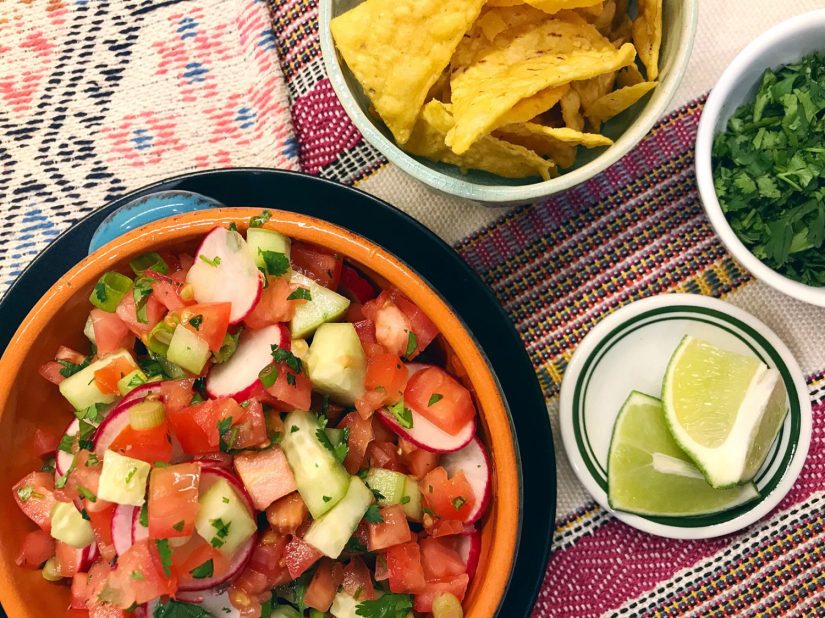
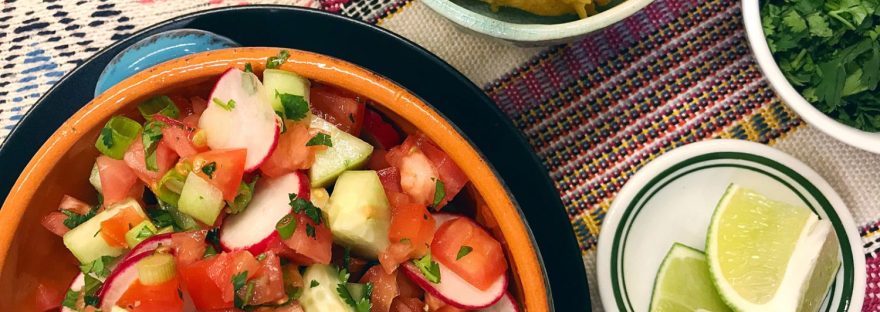
Pepino and Radish Salsa

Pico de Gallo

Salsa de Nopalitos

Grilled Pineapple Salsa

Ana’s Chipotle Salsa

Try them with tacos, burritos, scrambled eggs, tortas, tostadas, soups, and stews.  (I take a store-bought bottle of Cholula to the movies for my popcorn! Yeah, I do.)

Don’t see your favorite salsa here? Send us the recipe and we’ll send you a little something in return.  

〰️

De Las Mias app is ready for download.  Look for it at the Apple and Google Play Store. Follow us on Facebook and Instagram @delasmiaslife.


Healthy Mexican Food

Grilled Pineapple Salsa

Grilled Pineapple Salsa – ¡Que cosa tan rica!  This is a delicious salsa! Who knew that fruit salsas would become so popular? Most of us Mexicans grew up with las salsas madres of México, right?  Those are the classic, tomato, chile, onion and cilantro variety, and they are a staple on our tables, and in our tacos and burritos.  I never had a fruit salsa until I got to Santa Fe, New Mexico where culinary fusion is queen. But now, I love me a good fruit salsa.

This grilled pineapple salsa was developed and tested by Lori and Malena and you’re gonna love it.  If you’re brave, you can sneak in a pinch of habanero or chop up a mean little serrano, but just try it as is and kick it up later.

Fruit salsas pair great with meat, fish and poultry and this one with pineapple, is bien rica with carnitas, pork ribs, and grilled chicken. If you like fruit salsas, look for our peach and mango salsas.  And don’t forget our cranberry salsa for your Thanksgiving guajolote. Fruit salsas are a great way to liven up a taco!

Remember, you can make this salsa with other fruit besides pineapple, grilled peaches are lo máximo! If you don’t want to grill the chiles, it’s okay to remove the seeds and chop it up fresh! The best part of this recipe is grilling the pineapple.  If you haven’t had grilled pineapple, you are in for a treat.

In looking up the origins of fruit salsas, I found references to the Caribbean salsas made with mango, papaya and other tropical fruits, but not much else as far as the origins go.  I think it’s safe to say that fruit salsas are just another fabulous way we celebrate El Mestizaje – that bitter sweet fusion –  that got us all here in the first place.

¡Buen Provecho!

Healthy Mexican Food

Nopalito Salsa

Nopalito Salsa – Prickly Pear Cactus Salsa: Healthy, Tangy and Delicious

Did you say nopalito salsa? Cactus salsa?  Yes, amiga, that’s what I said!  Okay, first let’s dispel the stereotype that all Latinos eat cactus.  They don’t.  (You saw it here first!) Nopalitos are of the prickly pear variety, and they are healthy and delicious, and many Mexicans and Mexican Americans, but not all, eat them.  Case in point: I once brought a platter of nopalitos con chile to a picnic pot luck in Northern New Mexico and not one person ate them.  The hostess was kind enough to dip her spoon and take a bite and say something, like, “Tangy,”  but that was about it.  And nopalitos are tangy, and are made tangier with a squeeze of lemon or lime, but they are an acquired taste and not universally eaten by all Latinos.

But if you’ve had them and like them, try this simple and delicious salsa.  And if you haven’t had them, try them! Start with this simple, tangy and delicious salsa. Serve it with corn chips! YUM! Or make yourself a  little soft shell taco with a nice warm corn tortilla. DOUBLE YUM! It is also wonderful as a side dish!

This recipe is “seria.”  I say that because it was developed by Lori, La Madrina en la Cocina and she prepared the nopalitos from scratch.  You can find fresh-cut nopalitos already prepared and free of thorns at Mexican grocery stores.  So you could just buy them all ready to go.   But if you’re little lazy, or busy, or both, buy them in a  jar.  It’s okay not to be so Betty Crocker.  Just rinse them before you chop them up for the salsa.  Malena, our mera mera nutritionist would tell you, rinsing gets rid of some of the sodium, and that’s a good thing.

We made this nopalito salsa for our end-of-study party in Albuquerque and it was a big hit!  Try them today and feed them to your kids.  They can go to school and brag about eating cactus!

¡Hola, Sabrosa!, English, Healthy Family, Healthy Mexican Food

¡Salsa First!

Salsa Con Todo

There is an old saying that my Tía Paqui, one of my madrinas, used to say when she cooked up a good salsa: “¡Más vale la salsa que los chicharrones!” (The salsa is worth more than the chicharrones.)

Dichos are wonderful little bits of wisdom and at De Las Mías, we love our dichos. They are mini-lessons passed on by our abuelitas, moms and madrinas. You can find thousands of dichos in the Spanish language. 

The dicho, “Más vale la salsa que los chicharrones” aligns with the De Las Mías way of thinking.It means that salsa is highly valued in our kitchen culture. And in the case of chicharrones, we definitely want the salsa to be the star of the show and the chicharrón to be the supporting actor. The chicharrón is not your friend, comadre. And as my Tío Beto used to say, “Los chicharrones son muy traicioneros.” In English, this translates to “chicharrones are traitors,” (backstabbers!) They can basically kill you.

Some of us, like my sister, loves, loves, loves chicharrones. But chicharrones are firmly in the “poquitos por que son benditos,” category. You can still make a mean taco with a few chicharrones, though. You can. I’ve done it. I am speaking from experience. But let the salsa lead and postpone the heart attack.

(I’m only half kidding.)

High fat foods are killing us, comadres, and we need to dial it back. Fat makes food taste good, but salsa makes it taste GREAT! So when you’re cutting back on fat, a good way to not sacrifice flavor, not to mention, your way of life, is to liven it up with salsa!

Salsa is in our blood. Our indigenous grandmothers have been making salsas since before the Spaniards landed. 

A Mini-History of Salsa

Mexican salsas originated with the Aztecs. And apparently, the Incas and Mayans were no slackers when it came to to making these tasty  concoctions. (Ají, any one?) The base of a good salsa is, el chilito! You cannot have a good salsa without chiles, but the next most common ingredient is el tomate — the tomato. Both of these ingredients are native to the Americas. Salsa, of course, has evolved. For example, I am not sure when the onion showed up. But as the salsa evolved, many other healthy ingredients were added such as cilantro, parsley, epazote and other spices, and lest we forget, the heroic avocado! Today, there are hundreds of different kinds of salsas. We love fruit salsas, like mango, peach and jicama salsa.

Salsas can be raw or cooked. My own favorites are raw salsas, like Pico de Gallo with jalapeños or one good Hatch green chile, or even the humble Anaheim! But one thing is for sure, and that is that salsas are healthy foods that you can eat in great abundance and feel good about it. Get your veggies here, Comadres!

Salsa adds spice to life – le da sabor a la vida.  Even a simple bottle of Cholula will brighten up your taco.  And did you know that Louisiana Red Devil Sauce, la salsa del diablito, originated in New Orleans? Who knew? Here is a great article that you might find entertaining.

We love concocting recipes with native ingredients such as nopalitos, tomatoes, and chiles.  Here’s a list of native foods from the Americas,these ten things that have always been here:

Finally, did you know that cranberries are native to the Americas? Cranberry salsa, anyone? Are you ready for this? Easy cranberry salsa that you could become famous for, with only 5 raw ingredients: Fresh or frozen cranberries, an orange, a fresh jalapeño, a little bunch of cilantro, and yeah, a cup of sugar. But it’s okay, in moderation, remember? And for Thanksgiving! To go with your native guajolote? (Blend it up in a food processor and you are done.)

So pile on the salsas, comadres! And have yourself some of the healthiest food you can eat, while expressing your fabulous cultura. ¿Who says Mexican food is not healthy? ¡We don’t!

Here is a list of the salsas that you can find in La Cocina — De Las Mías:

Roasted Chile Salsa

Pepino and Radish Salsa

Pico de Gallo

Salsa de Nopalitos

Grilled Pineapple Salsa

Ana’s Chipotle Salsa

Try them with tacos, burritos, scrambled eggs, tortas, tostadas, soups, and stews.  (I take a store-bought bottle of Cholula to the movies for my popcorn! Yeah, I do.)

Don’t see your favorite salsa here? Send us the recipe and we’ll send you a little something in return.  

〰️

De Las Mias app is ready for download.  Look for it at the Apple and Google Play Store. Follow us on Facebook and Instagram @delasmiaslife.
 

¡Hola, Sabrosa!, English, Healthy Mexican Food

The Diversity of our Comida


We are so lucky to be Mexican! Hey, how often have you heard that lately? Well, it’s time to say it out loud, comadres!

Mexico is a fantastic country and the American Southwest, which at one time was part of Mexico, is a fantastic region. We are connected by land, our love of language, our love of familia, and our love of food. We are kindred spirits. In many instances, we did not cross the border. The border crossed us. So here we all are in this extraordinary land at an extraordinary time. This land mass that we occupy, Mexico and the North American Southwest, holds our roots and represents centuries of customs, languages and flavors. We come together to form a wonderful amalgamation.

Amalgamation is what happens when two or more cultures blend together to create a new one – in Spanish it is called Mestizaje. That’s what happened to us, our customs, our food and our way of life. ¡Que viva el Mestizaje!

It started when our Spanish ancestors landed in Vera Cruz, painful as it was for our indigenous brothers and sisters. It was a brutal birth, but the results were complex, rich, beautiful and diverse. Our food grew out of that mestizaje and now we have one of the most varied and delicious foods in the world.

From our Spanish ancestors we got wheat, cows, pigs, chicken, horses and sugar. From our indigenous ancestors we got corn, potatoes, tomatoes, chiles, and chocolate!

Say those words out loud and let your imagination and your taste buds explode!

If it hadn’t been for the Spaniards, we would not have our beloved flour tortillas. And where would be without the corn of our indigenous grandmothers? Picture a day without tacos, burritos, enchiladas, pozole, menudo, and tostadas, and picture a sad, sad day! Imagine New Mexico without the red, the green and the Christmas!

And don’t even get me started on where I personally would be without chocolate.

Every region of Mexico and the North American Southwest has its knockout specialty dishes and as De Las Mías grows, we want to proudly feature all of them and teach you how to enhance those dishes to make them healthier.


Here is a small run-down of our favorite Mexican and Southwestern foods and signature dishes.

  • Arizona: Machaca
  • California: Fish Tacos
  • New Mexico: Green Chile Stew
  • Texas: Fajitas
  • Oaxaca: Mole Negro
  • Puebla: Pipian
  • Sinaloa: Chilorio
  • Tijuana: Caesar Salad
  • Jalisco: Birria
  • Sonora: Caldo de Queso


Some of them you will find in De Las Mías and some of them you will have to dig around on your own.  Talk to your mothers, abuelas, madrinas and comadres. Hear their stories. Start collecting family recipes and pass them on. Pass them on to us and we’ll have our expert chef and nutritionist hack them for you and teach you how to make lighter versions that don’t compromise flavor. And when we can’t hack them and make them healthier, we won’t recommend that you give them up. If we can’t make it lighter, you will simply hear us say, ¡Go easy on the portion size, comadre!  

Enjoy our “Poquito de todo,” philosophy.

Enjoy the fruits of our amazing Mestizaje! Be a proud Latina enjoying the riches that our multicultural cornucopia has to offer – and ¡Buen Provecho!

As Evie Righter, author of the lovely little book, The Best of Mexico so aptly puts it, “Every cuisine in the world is rooted in history. And while volumes have been written about Mexico’s past, it is only recently that the cuisine of this dramatic, vibrant country has been chronicled for its extraordinary complexity and diversity and it is marvelous melding of different cultures and distinct regions. It is spirited; it is strong; it is from the ground up. Its beginnings are ancient.”

I love this paragraph and I see how it also applies to that same cultural legacy we benefit from in the American Southwest. At De Las Mías we will always strive to highlight the diversity of our food and strength of our cultural heritage. The changes we make in our test kitchen with the help of our chef Lori and our nutritionist Malena, will never compromise flavor and always strive to enhance your ¡Salud!

Here are some great resources we want to share with you to start exploring the glorious and exquisite foods of Mexico and the Southwest. Here are some of the books I keep on my shelf and 2 websites I am particularly fond of:


Books

Diane Kennedy’s – The Essential Cuisines of Mexico

A tattered copy of my mom’s — La Cocina de Doña Adela by Adela Romo de Escamilla


Websites

De Las Mías

Comida Mexicana


Other Books on my Shelf:

Susanna Palazuelos’ and Marilyn Tausend’s Mexico the Beautiful Cookbook

Evie Righter’s The Best of Mexico

Marilyn Tausend’s and Miguel Ravago’s Cocina de La Familia

Fabiola Cabeza de Vaca Gilbert’s The Good Life: New Mexico Traditions and Food

Jane Milton’s Mexican: Healthy Ways with a Favorite Cuisine


Healthy Mexican Food

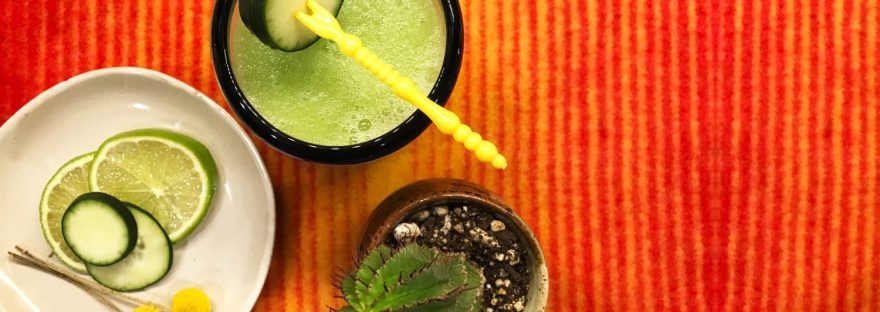
Agua Fresca de Cucumber

When I think of Agua Fresca I think of Mexican markets on hot days, of walking in from the street to a cool Mercado to find a fruit stand with rows of enormous glass jars filled with bright-colored refrescos – white for horchata – dark rich brown for Tamarindo – purple for Jamaica… and then there are the aguas made with fresh fruits and veggies, with less sugar but every bit as “quenchy” and delicious.

Here is a healthy recipe for Agua Fresca de Cucumber.

Agua Fresca de Cucumber is a refreshing way to get some veggies into your day and stay hydrated. Most of us don’t drink enough water every day.  If one of your healthy habit goals is to drink more water, this is a great way of doing it.  The added benefits to this agua de pepino is the pepino!  Cucumber is rich in vitamins C, K, and B, and also according to WebMD, rich in minerals like copper, phosphorus, potassium, and magnesium. It’s hard to drink the 6 glasses of water a day and pepino is 95% water!  This one has celery which adds even more vitamins and minerals, and lest we neglect our chilito, this one also has jalapeño!

This recipe for agua fresca does not call for straining the drink, but some agua fresca aficionados like to strain their aguas.  You can strain or not strain.  Up to you. We like to blend it and not strain it because the pulp contains fiber. But if you like your aguas to be more like the a traditional agua fresca that you would get in a Mexican market, strain away!

We encourage you to get creative and use other fruits such as watermelon and melon to make aguas.  You can add a little sugar or stevia if you like them sweet. Make ahead, strain and leave in the refri for later.

Happy Healthy Drinking – ¡Salud!

Healthy Mexican Food

Avocado Mojito Smoothie

Avocado Mojito Smoothie

This seemingly random combination of ingredients actually works to make a delicious and nutritious pick-me-up! If you like melon and you like avocado, you will love this licuado.  The coconut water, lime juice and mint give it a mojito vibe. This smoothie is a great way to get your healthy fat in from the avocado, as well as boosting your new habit of having more fruits and veggies every day.

Treat it as a satisfying elixir after-work or after-work-out!

We love this avocado smoothie because it’s great for breakfast too!  You can also turn it into a mid-day  meal by pairing it with protein.  It goes  nicely with a tuna salad, or tuna tacos, or you can keep it simple by making yourself a fresh ensaladilla with lettuce, tomato, and purple onion, dressed with a light olive oil vinaigrette.  With the olive oil and the avocado you’ve got your healthy fats covered.  And with a crisp, fresh salad with a little protein you are well on your way to treating your body right, Comadres!

Getting into the habit of adding healthy smoothies like this to your day will make it that much easier to live a healthier and satisfying life. Look for other De Las Mías smoothies and licuados in our La Cocina section and enjoy!

¡Andale!  You deserve to take care of yourself!

¡Buen Provecho!

Healthy Body, Healthy Mexican Food

What is Portion Control: Part 2


Becoming aware of serving sizes and how they impact your healthy eating goals is a key step toward healthy living.

We’ve said it before and we’ll say it again, De Las Mías is not about diets or deprivation. We don’t want you to stop eating anything that you love to eat. Even a sweet treat is okay in moderation.

The other day I was talking to a doctor, a specialist in diabetes, and we were discussing the traditional New Mexican diet. She said, “Face it—there is no way of making a healthy bizcochito,” and she is right. Traditional bizcochitos are made with flour, sugar and lard. Period. So, what to do? Are you really going to try to give up these tasty little morsels? I don’t think so. The next-best thing is to eat a smaller amount. Enjoy it, savor it and don’t overdo it.

So, if you’re used to dunking four bizcochitos into that hot chocolate on a cold winter’s eve, now you cut it by half. Dunk two and enjoy!

Giving up your favorite foods is just going to make you feel deprived, and we don’t want you to feel deprived. We want you to feel nourished and happy. Treating yourself once in a while is not going to hurt you; it might even make you happy. That’s why one of our favorite traditional dichos is “Una vez al año, no hace daño”—”Once a year doesn’t hurt.”  

We believe that, with small tweaks, a traditional recipe can be turned into a healthier recipe without sacrificing flavor. See what we have done with traditional green chile: we use olive oil instead of lard. Try our low-fat pozole recipe and taste a bit of heaven. And go ahead and make the enchiladas, but instead of frying them before rolling them, make them flat and use a little less cheese.

The De Las Mías recipes are chock-full of traditional foods made healthier, but even the best chef can’t get the fat out of the bizcochito. At those special times, just eat “un poquito,” a little less of it, and you’ll be fine.

And by the way, don’t begrudge yourself after you eat a special treat like that. Once you decide to indulge in the deliciousness of a homemade bizcochito, don’t ruin it by beating yourself up. Own it and go on to healthier options at your next meal. Remember, you always have a chance to have a healthier meal.

Here are five ways to cut down on serving sizes:

  1. Instead of four bizcochitos, have two.
  2. Divide a meal. Instead of having the whole burrito, eat half now and save the rest for later!
  3. Instead of two flour tortillas, have one flour and one corn tortilla.
  4. At a restaurant that serves chips and salsa along with big meal portions, simply skip the chips.
  5. Eat a salad before your main meal. That way you will naturally eat less and get your veggies to boot!

The biggest takeaway is this: By making small changes to your portion sizes, you can still enjoy your traditional foods. Cutting back on the amount of fat you eat is a good way to make healthy changes. You can cut back on fat without cutting back on flavor. If you follow these guidelines, you are well on your way to making healthy changes without compromising your passion for traditional foods.

Healthy Body, Healthy Mexican Food

What is Portion Control: Part 1


Do you have a grandma or madrina who’s always using old Spanish dichos to give you guidance?

Dichos are little golden nuggets of wisdom passed down by generations. They abound in New Mexico, Arizona, Colorado, Texas and California.

Not surprisingly, there are many dichos about food, like the New Mexican favorite, “Panza llena corazón contento.” That one (full stomach, happy heart) could get you in a whole lot of trouble if you let it. Better to counter it with “Poquito porque es bendito,” (A little bit because it’s sacred). Sooo much more civilized, and your abuelita would approve. It cultivates honoring your food as if it is sacred.

I’m sure many of you have seen your tíos or tías crossing themselves before they dive into a bowl of pozole. That’s the same idea: blessing your food, pausing and becoming aware of how delicious it looks and how grateful you are to be enjoying such a lovely meal…

Now think about this: what if you treated your body as if it were a sacred place, as if it were the temple in which you live? Imagine, if you treated your body with that much respect and love, how eating would change for you.

What if “poquito porque es bendito” guided your daily enjoyment of food? This old dicho passed on to us by our ancestors is perfectly aligned with our De Las Mías philosophy of “Poquito de Todo”—eat a little of everything.

At De Las Mías we want you to be passionate about food and passionate about your body. We want you to be Food Positive and Body Positive. We want you to embrace the deliciousness of our food and our cultural connection to it, and we want you to love and accept your body as it is now.

In keeping with our Poquito de Todo philosophy, we want you to make healthy changes that will result in a more empowered life and a healthier connection with your body. By embracing this “eat a little of everything” approach, you can make slight changes that will result in better health.

One of the ways to do that is to become aware of the size of your servings. We don’t want you to give up your favorite foods and family recipes—we just want you to reduce those serving sizes.

One tool to get a handle on serving sizes is our En Tus Manos Infographic. This handy little tool shows you how to use your hands, like your grandma did back in her day, to measure food.

Try it and let us know how it goes!

Check out our other articles in Healthy Mexican Food for ideas on how to cut down on serving sizes and enjoy your food.