¡Hola, Comadres!, ¡Hola, Guapa!, ¡Hola, Madrina!, Spanish

Con la ayuda de nuestras comadres: parte 2

La semana pasada aprendimos que varios estudios han comprobado que los fuertes lazos que tenemos como latinas en nuestras familias, en nuestras amistades y nuestras comunidades nos protegen, y que nos pueden ayudar a lograr cambios saludables. Esta semana, quiero compartir una historia personal y una práctica que espero les parezca útil.

Con el apoyo de mi comadre

Miriam y yo nos hemos ayudado una a la otra a través de muchos cambios de vida   — incluyendo la muerte de su esposo, mi divorcio, sacar adelante a nuestras hijas, desarrollar nuestras carreras, la lucha de prevención contra la diabetes y hasta en el decorado de nuestros hogares. Pero lo mejor de todo ha sido ayudarnos una a la otra a vivir una vida sana y feliz. Cada año, alrededor del primer día del otoño, Miriam y yo nos juntamos y sostenemos la misma plática, con un proceso muy específico. Hacemos una lista sobre los 7 aspectos más importantes de nuestras vidas:   

  • Relaciones personales
  • Aspectos de salud y bienestar
  • Aspectos financieros
  • El ambiente donde vivimos
  • Carrera y trabajo
  • Expresión creativa
  • Cuidado de nuestra paz interior

Recorremos cada una de las 7 áreas de nuestra vida y nos turnamos para hablar sobre cada uno de los aspectos.  Esto lo hacemos sin interrupciones. Sólo escuchamos lo que cada una tiene que decir. No hacemos comentarios hasta el final de la plática. Respondemos a 4 preguntas básicas para cada uno de los 7 aspectos:

  1. ¿Qué ha resultado bien?
  2. ¿Qué no ha resultado tan bien?
  3. ¿Qué nos gustaría cambiar?
  4. ¿Qué tipo de apoyo o ayuda necesitamos una de la otra para lograr el cambio que queremos?

A través de los años, esta plática nos ha ayudado a lograr muchas metas. Hemos mejorado nuestras carreras, mejorado las relaciones con nuestras hijas, tomado mejores decisiones en nuestros negocios y hasta nos hemos convertido en mejores escritoras. Las dos hemos llegado a ser más sanas y felices. (Y no es por nada, pero las dos bajamos cerca de 25 libras de una manera saludable y sin mucho sufrir.) Nuestra plática de cada año es una de las cosas más valiosas y consistentes que hemos hecho con nuestras vidas y han enriquecido nuestra amistad. Ahora ya estamos en nuestros sesentas, y es justo decir que somos personas más satisfechas y felices como resultado de esta simple plática de todos los años. Miriam y yo confiamos una en la otra.  Nos tenemos tal confianza que a veces admitimos que no queremos hacer lo que tenemos que hacer, o bien, que no estamos listas para cambiar. Simplemente con admitir que estamos luchando nos ayuda a derribar barreras. A veces tenemos éxito y a veces no.  Pero siempre somos fieles en ayudarnos una a la otra sin juzgarnos. Sabemos que cada una de nosotras sólo quiere lo mejor para la otra. Tener una comadre, una amiga de apoyo, en nuestras vidas puede ser de gran ayuda para lograr cualquier meta e incluso para lograr una vida saludable y feliz.

¡Hola, Guapa!, Edición No. 2: Support, English, Healthy Comadres

With a Little Help from Our Comadres: Part Two

Last week we learned that researchers have validated that the strong bonds we have as Latinas in our traditional familias and friendships protect us—and can help us make healthy changes.

This week, I want to share a personal story and una práctica (a practice).

A Balanced Life with Help From Our Comadres

Miriam and I have helped each other through many life changes—including the death of her husband, my divorce, raising our daughters, becoming more prosperous, building our careers, decorating our homes, preventing and managing diabetes and, above all, living a healthy and happy life.


Each year, around the first day of Autumn, we get together and go through a plática process we started over 20 years ago. We make a list of the 7 most important areas of our lives and review our progress and make vows for changes for the following year.

  • Personal Relationships
  • Aspects of Health and Wellness
  • Aspects of Prosperity
  • Living Environment
  • Career and Work
  • Creative Expression
  • Care of the Soul

We go through each of the seven areas of our life and take turns speaking with no interruption or cross talk. We just listen to what each has to say and make no comment until the end.

We answer four basic questions for each of the seven areas:

  1. What went well?
  2. What didn’t go so well?
  3. What would we like to change?
  4. What kind of help do we need from each other?

Using this process has helped the two of us accomplish many things throughout the years. We have improved our careers, become wiser mothers, better partners, more creative writers and artists.

We have made more money and avoided making expensive interior decorating mistakes. We have both become healthier and happier and, oh yeah, we have both lost about 25 pounds each.

Continued Success with a Supportive Friend

Our annual conversation is one of the most valuable and consistent things I have done with my life and my comadre and supportive friend, Miriam, for 20 years. Our friendship has grown and deepened. We are in our 60s now, and it is fair to say that we are more fulfilled and happy as a result of this bond that is based on listening to each other, tracking each other and caring for each other’s happiness.

In the area of health and wellness, Miriam and I have made great progress. We have used this method for achieving a healthier, more balanced life.

This year, I shared with Miriam that one aspect of health and wellness that went very well for me last year was biking. (I bike six miles a day!) She smiled without comment. Just seeing her face made me proud of myself.

When I shared aspects that didn’t go so well, I shared that my arms felt like mush. Again, no judgment from her. Just a nod that she was hearing me.

When I got to Question Three—what I would like to change—I told her that I needed to keep up my arm strength, that I wanted to be a strong old lady, one who can pick up her own suitcase and put it in the overhead compartment. She still looked at me wisely and smiled.

And when we got to Question Four, Mir asked, “How can I help?”

After thinking a bit, I said, “I guess I need some suggestions, since I really detest going to the gym to lift weights.”

That is when Miriam finally spoke to give me advice. She said, “First of all, you don’t have to go to the gym if you don’t like it.” She then suggested that I get some exercise bands and told me about a YouTube video she used when she started doing arm-strengthening exercises. Knowing me and my love of television, Miriam even suggested I keep some bands by the couch!
I vowed to try it twice this week just to see how it would go.

She gave me a high five and asked, “Do you want to check in with me next week, and let me know?”

I accepted her offer and told her that I could also just shoot her an email or a text.

I then did the same for her. Her goal was to increase her walking by five minutes a day, three times a week. We went through the same process and vowed to check in and help each other out.

Miriam and I trust each other—we have confianza. Sometimes we admit to each other that we don’t want to do what it takes, that we aren’t ready for change.

Just admitting that we are struggling helps break down the barriers. Sometimes we are successful and sometimes we aren’t, but we are always faithful about helping each other without judgment. We know that each of us only wants the best for the other. We both feel supported and cared for.

Having a comadre, a supportive friend, in your life can help you achieve a healthier, happier life. This plática process is a concrete way to get help from our comadres.

Learn more about how to be a supportive friend in part three.

¡Hola, Guapa!, Edición No. 2: Support, English, Healthy Comadres

With a Little Help from Our Comadres: Part One

Health researchers tell us what we already know, that the Latin American family has some built-in protective factors related to the closeness and support we get from our extended families. Although most of us Latinas already know that, it sure is nice to have it affirmed by scholars and health researchers.

We know from experience, the value of our familias, and we know that our fierce love protects us. Now researchers are recognizing these strong bonds as something positive and they call it “protective factors.”

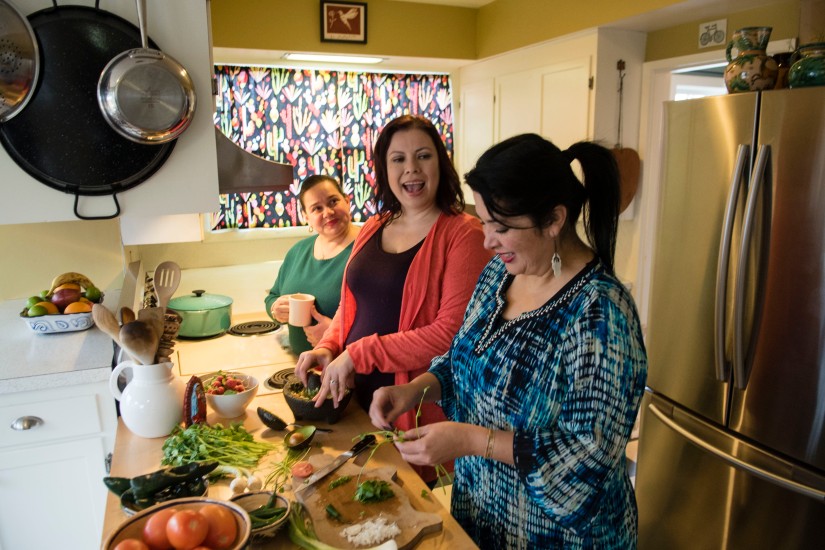
Women in kitchen 2

A Healthier Life with Help From Our Comadres

We don’t need fancy nouvelle cookbooks to tell us how delicious, varied and nutritious our food is. We know our comida rocks, but now there are hundreds of new books on the marvels of the Latin American kitchen.

Just as we already know how important our families and our food are to us, we also know what the research has confirmed about female friendship and support. A recent study conducted by Brown Medical School and University of Minnesota found that women who joined a weight loss program with a supportive friend were much more successful than when they joined alone.

Latinas have always had strong female bonds that uphold and protect us. And now the research affirms that this bond can help us achieve a healthier life.

Next week I’ll share a personal experience about how my comadre, Miriam, and I have been peer-coaching each other for more than 20 years, with stellar results. Check out part two and learn how Miriam and I helped each other through many life changes.

¡Hola, Guapa!, English, Healthy Body

How to Become a Body-Positive Supermujer

¿Sabes Que?

Women of all ages can be negatively affected by mainstream ideals of thinness and white beauty standards in the media. Research shows that proudly embracing your cultura Latina and surrounding yourself with positive role models can improve your body image.

Your body moves you. It carries you throughout the day, sometimes holding el peso del mundo on your shoulders. The stresses of work, school or family can add up, but how you respect and treat your body can protect you.

Treating your body with kindness and respect nurtures it with energy and positivity. Love your body by moving it and keeping it fit. Respect your body by eating delicious and nutritious food. Start looking at your body with appreciation instead of criticism. All these choices help you develop a positive body image.

Having a positive body image and healthy self-esteem is key to living a happy life.

What Is Body Image?

Body image is how you think of your body. When you look in the mirror or picture yourself, what do you feel? Acceptance or criticism? This is part of your body image. Body image encompasses what you believe and feel about your appearance, your weight, shape and height. Your body image is also about how you sense your body as it moves.

We want you to be a Body-Positive Supermujer because negative body image can hurt you. It can affect your relationships and how you communicate with others. Negative body image can contribute to low self-esteem and eating disorders, and chip away at your overall health and well-being.

Take a look at these signs and check in with yourself.

Signs You Might Have Body Image Challenges

  • Do you think of a part of your body with distaste or disgust?
  • Are you convinced that only other people are attractive and that your body size or shape is a sign of personal failure?
  • Do you feel ashamed, self-conscious and anxious about your body?
  • Do you feel incómoda and awkward in your body?
  • Do you catch yourself criticizing your body or the way you look?
  • Do you criticize other women’s bodies?

Signs You Have Positive Body Image

  • Do you feel acceptance and love for your body?
  • Do you celebrate and appreciate your figura natural?
  • Do you love your curves?
  • Do you understand that how a person looks says nothing about their character and value as a person?
  • Do you feel orgullosa and accepting of your unique body?
  • Do you love your body as it is now?
  • Do you refuse to spend an unreasonable amount of time worrying about food, weight and calories?
  • Do you feel comfortable and confident in your body?
  • Do you appreciate the way your body serves you?

What Affects Body Image?

How you perceive your body is complex. Many factors affect body image, including where you were born, how you were raised, who your role models are or were, and the social groups you not only interact with, but compare yourself to. Today’s media-focused mainstream culture has more power than ever to influence Latina body image.

¿Sabes qué? Latinas who watch four or more hours of TV a day or spend that amount of time on social media have a less favorable body image than Latinas who don’t.

Some researchers say it’s because mainstream media and advertisers push their distorted definition of beauty. Many times this definition doesn’t match ours. They portray certain values, people and themes in a way that make you feel like your uniqueness is wrong. This portrayal creates a warped illusion of reality that idealizes thinness and extreme Western beauty standards. This warped illusion can lead women to create unhealthy comparisons to the women they see in the media. This is bad for all women, but it is beginning to affect Latinas and you need to alert yourselves to it and reject it.

Did you know that…or ¿Sabes Qué? Latinas who watch four or more hours of TV a day or spend that amount of time on social media have a less favorable body image than Latinas who don’t.

How your Latina identity can improve body image…Now for the good news…

Latinas are strong, passionate and proud, and all of these characteristics should be embraced to improve your overall self-image. In a recent research study, women who identified as Latina—those who embraced their strong ethnic identity—described their bodies more positively and were better able to fight off the negative effects of media consumption than those who didn’t identify as Latinas. So as it turns out, when you embrace your cultural identity—tu cultura Latina—you are more likely to accept and celebrate body types of all shapes, colors, ages and sizes.

Embracing your cultural identity helps combat the over-sexualized or stereotypical body images of Latinas that the media tend to portray. In the language of social research, this is called a Protective Factor. Translation: Your cultural identity can protect you from the distorted body images that are portrayed in the media. ¡Eso!

Here are some ways you can draw from your cultura and boost your body image and self image:

  1. Surround yourself with positivity in your social and family environments. Research shows that when Latinas receive strong cultural support, their ideals for extreme thinness and Western beauty standards decrease. This results in a happier, healthier you.
  2. Even if you want to shed a few pounds, love your body as it is now. Adorn it, love it, accept it.
  3. If you think you might be having body image issues, stop reading beauty magazines that prescribe what a woman is supposed to look like. Look for images of Latinas who are beautiful because they are real, earthy, strong and powerful.
  4. Look for your own definition of a Supermujer and remember Latinas come in all colors, shapes and sizes.
  5. Next time you look in the mirror, stop to remember who you are and where you came from. Your heritage y cultura is built on a foundation of tradition, resiliency, love and support.
  6. Spend a few minutes a day meditating on your body. Practice being grateful for how your body serves you. Reflect on how you will take care of it starting today.
  7. Reject the mainstream definition of beauty and embrace your unique inner belleza and self-love.
  8. Enjoy comida y cultura. Express your love for your favorite foods. Learn to cook traditional and nontraditional foods. Cook for others and cook for yourself. Savor food. Enjoy it. Eat when you’re hungry. Stop when you’re full.
  9. Treat your body with love and respect.
  • Comb your hair like a loving aunt or madrina might have when you were a child
  • Treat yourself to a nice bubble bath
  • Ask your partner for a massage, or give someone a deep hug
  • Buy a nice soap or lotion for your skin. Rub your skin gently with lotion or special oils
  • Adorn your body with jewelry or other accessories that express pride for your culture
  • Wear lipstick like your favorite aunt or madrina
  • Take your body for a walk and enjoy nature
  • Dance your body. Move it to your favorite music
  • Make a list of the reasons you appreciate your body
¡Hola, Guapa!, English, Healthy Body

Getting on the Scale

A message from Madrina Ana…

I always hated the scale. Did you know that I used to be so anxious about weighing myself that my blood pressure would go up when I went to the doctor for a simple checkup?

Yup. That was me.

I have had many years now of getting healthy, and honestly, it is a one-day-at-a-time proposition, as our hermanos and hermanas say in Alcoholics Anonymous. Those of us who have made healthy changes to protect our health and wear cuter clothes know that it is a step-by-step process. We just try our best and put one foot in front of the other.

Weighing ourselves can be a nightmare if we let it. And the way to reframe the nightmare is to think of it as just one tool that can help us make healthy changes.

Remember: the number on the scale is just that: A number. It is one tool. There are many others.

At De Las Mías we recommend that you weigh yourself once a week. Period. Try not to weigh yourself every five minutes. It’s not that good for you to get too focused on your weight.

¡No vale la pena! (It ain’t worth it.)

Weighing ourselves falls under the category of “self-monitoring.” That means watching yourself, becoming more aware of yourself and what you do. Research shows that people who self-monitor make more progress in achieving healthy weight than those who don’t. But using the scale to “watch your weight” is just one tool.

Other ways to self-monitor are: Measuring your waist. Paying attention to how your clothes fit. Noticing how many veggies you’re eating now as opposed to last month. Becoming aware of how much energy you have. How good you feel about the healthy changes you’re making. How much you are enjoying those walks with your kids, your hubby, your comadre, your dog or yourself. How free you feel on your bike on a sunny day! How proud you are to be feeding your family healthier food. How fun it is to try a new recipe!

Those are all ways to “watch yourself,” to become more aware of what you are doing and how you are loving and respecting your body as you get healthier.

If you follow our “Poquito de Todo” philosophy, you will eat better, and as you eat better, you will become healthier and achieve a healthier weight.

We want you to love your body, love your food and be a role model for your children and your comadres, sisters and friends. We want you to do it “Poquito a Poquito,” one healthy step at a time.

So, weigh yourself once a week and remember that the number on the scale is just a number.

Keep up the effort. ¡Vales la Pena! (You’re worth it!)

¡Hola, Guapa!, Edición No. 1: Getting Started, English, Healthy Comadres

Healthy Changes: Don’t Go It Alone—Tell Your Comadre

Making healthy changes isn’t easy—it takes commitment and hard work.. The good news is: you don’t have to go it alone. Starting a new healthy lifestyle journey is much easier with a comadre by your side. Keep in mind that it is even better if your comadre is also on a healthy lifestyle journey.

You’ve told yourself, “I am ready to make this change.” ¡Estás lista!

Now it’s time to take the extra step and tell your comadre you’re ready. The experts tell us it is important to tell another person we’re ready to make a change. This increases our commitment and the chances of success!

Now’s the time! ¡Ahora es cuando! Turn to your comadre, sister, friend, mom or madrina and tell her, “I’m ready to make a change. This is my plan. Will you help me stay on track?”

Okay, you assessed and declared that you’re ready, you’ve told a comadre and now you make the necessary preparations! Just like you take out the utensils, the bowls and the ingredients to prep for a meal, you have to prep to take action.

Ask yourself, What do I need to make this change?

Try this:

  1. Identify the change you want to make.
  2. Declare yourself ready.
  3. Make a plan. (Write it down.)
  4. Share it with your comadre!
  5. It helps to tell her how you want her to help: Give me an ¡Eso! when I meet my goal. Go with me on my daily walk. Call me in a week if I haven’t called you.

We’ve written plans to commit to healthy changes plenty of times over the years. Here’s an example of one that works well when you’re starting a new healthy lifestyle. Feel free to make it your own!

An Easy Plan for Committing to Healthy Changes

This is the small change I would like to make: I would like to eat fruit instead of cookies when I watch TV.

To get ready I need to:

  1. Buy oranges.
  2. Keep them in a bowl by the TV.
  3. Call my comadre and tell her my plan. (Increase your chance of success by setting a start date!)
  4. Commit to check in with her at the end of the week whether I make it or not.
  5. If I don’t meet my goal, I promise to try again.

¡Adelante! You are on your way to making healthy changes, one small step at a time.

Buena Suerte, Comadre! We wish you luck as you make your commitment to healthy changes. To get into action, follow the De Las Mías ¡Un Poquito de Todo Philosophy!

¡Hola, Guapa!, Edición No. 1: Getting Started, English, Healthy Body

Get Started with Physical Activity

¿Sabes qué? Most Latinas—60% of us—are not physically active. ¡Basta! Let’s change that story!

Mely riding bike 1

Many of us are intimidated by what “physical activity” means. Health education research shows that some people don’t even like the word “exercise.”

We hear the words “physical activity” or “exercise” and we imagine pictures of sweaty, skinny chicas in their tight little outfits at the gym and we say, “¡Ay, no!” “¡Chale!” “Forget it!”

Get started with physical activity and move your body!

Honestly, comadres, it’s not that big of a deal. Here’s our official DLM advice about being fit:

¡Move your body! ¡Enjoy it!

Dance it. Love it. Walk it. Bike it. Run it. Grow a garden with it. Please it. Be proud of it. Stop comparing it.

Move it as much as you can. Engage in a fun physical activity at least five days a week for 30 minutes a day and give yourself a big ¡Eso! (Maybe even a ¡beso!)

Here are some of the top benefits of physical activity:

    • Gives you energy
    • Improves your mood
    • Improves your confidence
    • Improves your sex life (¡Créemelo!—Believe it!)
    • Helps you manage stress
    • Helps you lose weight
    • Helps you control your weight
    • Lowers your risk of heart disease, diabetes, and some cancers

Continue reading “Get Started with Physical Activity”

¡Hola, Guapa!, English

Avoiding the Thin Trap: A Letter From De Las Mías Founder

A letter from De Las Mías founder Ana Consuelo Matiella

Late the other night, I couldn’t sleep, so I decided to turn on Netflix. Since I craved laughter, I found a list of Mexican comedians and I clicked on Ricardo O’Farrill. Funny! Laugh-out-loud funny. When he got to making fun of Jews I sat up straight on my bed and said, “Uh-oh.” His Jewish joke, the one I heard, wasn’t terribly offensive. If I recall, it was making fun of the Hebrew pronunciation of Spanish. Okay, I said, I can live with that. Laughter is a stress-reliever so I kept watching. Lots of cussing and swearing, but, hey, that can be funny, right? I’m from the state of Sonora. I can swear you under the table. I have cousins who cannot speak if they can’t say something related to the word chingar. O’Farrill sounded like he was quoting out of a dictionary called El Chingonario, which I happen to have on my shelf right now. A gift from another cousin…this one from Magdalena, Sonora. So I kept watching. I was giggling away when he got to the “fat chick” jokes. “Ha-ha!” the audience laughed. They laughed at the gorda jokes, the ones about how the gordas jiggled when they danced at the nightclub, and how funny it was that the gordas, because they were fat, weren’t going to get to have sex after the party. Quoting the Chingonario, I whispered an insult to his mother, and logged off. O’Farrill, funny guy that he is, it took me back to my childhood and the memory of all the fat jokes I had to endure as a big, chubby girl growing up in Nogales, Arizona. It took me back to my mother, and the picture I have of her wearing the tight black skirt and form-fitting matching sweater. She’s leaning like Ava Gardner against the rustic wall of our TV room, smoking a cigarette. So sexy, my mama. I remember helping her out of her girdle at night after she and my dad got home from the parties. It was flesh-colored pink and it had metal stays. My mama was never fat. She never had to hear gorda jokes aimed at her. She was beautiful and, above all, thin. She had this expression she used when she wanted to communicate that a woman was doing well. If she ran into someone at the market and recounted it to my tia, she would say something like, “I ran into Chalita at the store.” My aunt would say, “And how is she these days?” And my mom would answer, “Oh she’s fine, and above all, thin.” That was the final clincher. Sobre Todo Delgada.

Worried About Being Thin? Here’s a Cautionary Tale.

My mom was born in 1932 and came into adult womanhood in Mexico during World War II; she had stories of rationed silk stockings that she treasured like precious jewels. She was a fashion plate. She cared so much about what she looked like that she suffered from it. She was beautiful and stylish and, above all, thin. She was also bulimic. She was on prescription diet pills that at the time were called “Black Beauties.” My mom had an eating disorder and it stemmed from her deepest desire to be thin, because that meant she had worth. She and O’Farrill were on the same wavelength, except that she wouldn’t have laughed at his jokes. She would have been embarrassed that O’Farrill might have been making fun of her daughter, even as she was feeding her steak and no carbs. Like O’Farrill, my mom wanted her girls to be thin. Having a chunky daughter did not sit well with her. She tried to put me on various diets. She knew a thing or two about the no-carb diet. Thanks to Vanidades magazine, Atkins was a household word at our house in 1965. Looking back, I believe the doctor was treating her binging-and-purging—her bulimia—with Biphetamine, rationalizing that if she weren’t hungry, she wouldn’t binge. But when the Biphetamines made her jittery, he gave her Valium. She was a classic case for the times: while my mom might have benefitted from a good therapist, she was simply given pills to solve her problems. But she was never fat, and for my mom, that was, above all, the most important thing. So, one day when I was about 15 and she saw that my clothes were getting too tight, she said, “Ya no comas pan.” No more bread and tortillas for me. This was my first weight-loss diet: Breakfast: a hard-boiled egg and what she called “diet bread.” (This tasted a bit like cardboard.) Lunch: I was supposed to take carrots and celery but I discovered tortilla chips and Coke at the Charrito’s stand at the high school. (The Charrito was a blind guy who sold junk food to kids out of his makeshift cargo bike. He was ahead of his time.) Dinner: A steak and a salad. No oil. Just vinegar. A pear or an apple for dessert. Look it wasn’t a terrible diet, okay? I get it. She wanted me to be attractive and Sobre Todo Delgada and she was trying her best to be a good mom and protect me from fat jokes and bad outfits. I get it, but early on I also got this message: A woman is worth more when she’s thin.

Focus on a Healthy Body, Not a Thin Body

I am 65 years old now and have tried many more diets. As a health educator, I have made great strides. I switched from being on a diet to learning to eat in a healthy way. It took years of hard work for me to realize that my self-worth, confidence, power and self-esteem are not determined by how thin or fat my body is. You might think that the problem I faced 50 years ago has gone away, and that we have evolved from thinking that a woman’s self-worth is based how much she weighs. Alas, it is still with us! This distorted and cruel way of defining self-worth for women is still here. O’Farrill, a modern Mexican man, gets laughs because people still laugh at jokes about gordas. And there is something wrong with that. I founded De Las Mías because I want Latinas to be healthy, powerful and confident. And yes, of course, I want us to express our cariño, our beauty and our femininity. We believe that we can learn to love, nurture and take care of ourselves and our bodies without becoming overly focused on thinness. De Las Mias is about being healthy and adopting new behaviors that will result in a healthier life. I don’t want you to be Sobre Todo Delgada, I want you to be ¡Sobre Todo Healthy and Powerful! Focus on being healthy—avoid worrying about being thin. Learn to love yourself and your body. You are beautiful the way you are, comadre.

¡Hola, Comadres!, ¡Hola, Guapa!, ¡Hola, Madrina!, English, Healthy Body, Healthy Comadres

Find a Physical Activity That Brings You Joy

Physical activity keeps our hearts fit and pumping oxygen, our muscles strong and our joints healthy. The only way to do this is to move. You don’t have to be a superstar athlete to reap the benefits. Finding a physical activity that brings you joy means taking the “work” out of workout. Here’s a story from our resident fitness coach, Madrina Yoli, that will inspire you to move.

Why We Need to Be Active

I remember when my mom was turning 50 and going through the changes. She came home and told me, “Mija, the doctor said I had to start an exercise program. ¡Ay Dios! I can’t do all you do! I will die!” I was just finishing my degree in exercise physiology and was eager to help her. So I started by explaining to her the reason why we need to be active and how it will help her body. “Mami, you do not need to run a marathon or be a weightlifter to be healthy. You can do things like walk to the store instead of drive. Do some stretching while you watch TV, or maybe we can get you a stationary bike. We could even plant a garden with flowers and vegetables in the backyard and working on it will be part of your exercise.” She said, “I’m ready to start!” I said, “Okay! I will be your exercise comadre—it’s best if you have a training buddy.” We started by writing down her goals for the week in a workout journal. I showed her, “See, here are all of your goals for each day, and here you write down when you complete them in order to keep track of your progress.” I taught her that we needed to start slow in order to let her ligaments and tendons grow stronger to avoid injuries. After that, we started to work on the heart and I reminded her the only way to work out the heart is through aerobic exercise. All you need to do is increase your heart rate. Our ultimate goal was 150 minutes of aerobic exercise per week, so we started out with three 30-minute sessions per week and picked her favorite exercises: dancing and walking. “Later on, Mami,ˮ I said, “we can get you some resistance bands and begin to work on some strength training, but for now, just remember one important thing.” “What’s that, Mija?” “Have fun!” After 12 weeks, we could see a big difference. Find a physical activity that brings you joy and you will see a difference too.

¡Hola, Guapa!, Edición No. 1: Getting Started, English, Healthy Comadres

Starting a Healthy Lifestyle is Easier Than You Think

We are pleased to welcome you to Edición No. 1 of the De Las Mías online revista! Each edición features articles and recipes to inspire and inform you to start a healthy, balanced lifestyle.

Start a healthy lifestyle. Go from thinking to doing.

Here are articles that will help you move into action:

Moderation is the key to a balanced life. We know from our own experience—and the experiences from our comadres—starting a healthy lifestyle is easier than you think.

Ready for a healthy, balanced lifestyle?

Ready to get started? Click here for the next article.