English, Healthy Mexican Food, Recipes

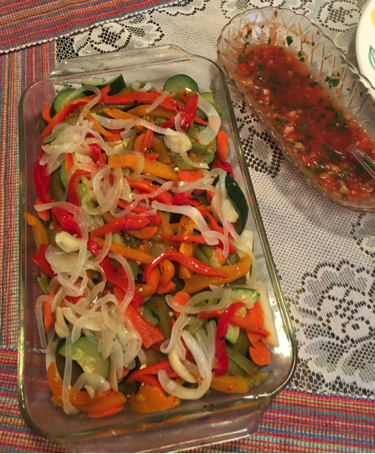
Stuffed Anaheim Chiles

Veggie rich and delicious as an appetizer.

  1. Place the sliced onion in ice water for 15 minutes. Drain and set aside.
  2. Bring a pot of water to boil and parboil the carrots until tender but not soft, about 10 minutes; rinse in cold water immediately and set aside.
  3. Heat a skillet with 1 teaspoon of olive oil and sauté the zucchini slices until tender but not soft; season with salt and pepper.
  4. Place all vegetable ingredients, the vinegar and the remaining 2 teaspoons of oil in a large bowl and gently toss; let the mixture sit for 15 minutes.
  5. Take the Anaheim chiles, cut them in half lengthwise, and add a cheese slice to each chile half.
  6. Place the cheese-filled peppers in a serving dish and spread the vegetables on top.
  7. Serve with warm corn tortillas.
advanced Level | 45 minutes Total time | 80 Calories

Ingredients:

  • 1 onion, peeled and sliced
  • 4 carrots, peeled and sliced
  • 2 red bell peppers, roasted, peeled and seeded, sliced
  • 2 yellow peppers, roasted and seeded, sliced
  • 2 zucchini, sliced
  • 4 Anaheim chiles, roasted, peeled, seeded, top removed
  • 8 slices queso fresco (about 1/2 oz. each slice)
  • 1 t salt
  • T cider vinegar
  • 1 T olive oil, divided

Nutrition Information:

Total fat: 3 g; Saturated fat: 1 g; Trans fat: 0 g; Cholesterol: 5 mg; Sodium: 330 mg; Carbohydrates: 11 g; Fiber: 2 g; Sugars: 6 g; Protein: 3 g; Vitamin D: 0 mcg; Calcium: 65 mg; Iron: .7 mg; Potassium: 316 mg

English, Healthy Mexican Food, Recipes

Tuna Tacos

This is an easy lunch to prepare ahead of time and take to work.

  1. Combine the tomato, onion, celery and cilantro in a bowl. Squeeze the juice of the lime and mix in gently. Add the already drained tuna and blend.
  2. Add diced jalapeño (optional). Season lightly with salt and sprinkle more lime juice if needed. Cover and chill in the refrigerator for 20 minutes.
  3. Warm corn tortillas in a hot skillet or comal. Divide the tuna salad among three tortillas and roll up.
easy Level | 30 minutes Total time | 330 Calories

Ingredients:

  • 1 small tomato, chopped
  • c finely chopped red onion
  • 1 celery stalk, finely chopped
  • 1 T chopped fresh cilantro
  • 1 fresh lime
  • 1 5-ounce can of tuna packed in water, drained
  • 1 jalapeño pepper, seeded, finely diced (optional)
  • t salt
  • 3 small (4-inch) corn tortillas, warmed

Nutrition Information:

Total fat: 5 g; Saturated fat: 1 g; Trans fat: 0 g; Cholesterol: 40 mg; Sodium: 80 mg; Carbohydrates: 43 g; Fiber: 7 g; Sugars: 8 g; Protein: 28 g; Potassium: 577 g

¡Hola, Guapa!, English, Healthy Body

Should I Lose Weight?

Should I Lose Weight? 

How many times have you asked yourself this question? At De Las Mías, we would like you to rephrase the question and ask yourself, “Should I be taking better care of myself?” If you haven’t already done so, read my story, Avoiding the Thin Trap: A Letter From De Las Mías Founder. This is a personal story about how being raised to be “Sobre todo delgada,” can leave you feeling bad about yourself with the extra bonus of an eating disorder.

How Did We Get Here?

Maybe your doctor has told you that you need to lose a few pounds to get you out of the danger zone.  (Diabetes, Heart Disease, High Blood Pressure, Some Cancers) Maybe you already have prediabetes. Maybe your mom and abuela already have diabetes and you don’t want it. Maybe your boyfriend makes comments about another woman’s hot body and she weighs 30 pounds less than you do. Maybe your jeans are too tight and it doesn’t feel good. Maybe you want to look like J. Lo Maybe you looked at your BMI.

Moving on to a Healthier and More Natural Weight

There are many reasons, and some of them are good reasons, why it’s important to get to a healthier and more natural weight, but labeling yourself, comparing your body to others’, and going on some crazy deprivation diet is not going to get you there. That’s one of the reasons why we are abandoning the use of BMI as a measure of healthy weight.

Abandoning the BMI

Traditionally, the BMI was developed as one way of assessing if someone needed to lose weight. It has been used as a way to help assess if people are in the “healthy weight” category for over 100 years.   The Body Mass Index is simply a number based on your weight and height.  So for over 100 years, the general premise of the BMI has been that the higher your BMI is the more fat you have in your body. But as time has gone by, scientists have realized that the BMI does not actually measure the percentage of fat, muscle or bone in your body. A recent article, Is B.M.I. a Scam? – The New York Times does a great job at explaining how the BMI has been used in the past and how it can be helpful, or harmful.  For example, it states that BMI measures are sometimes useful in researching weight health.  And in fact, we used BMI measures in our own NIH funded research, in looking at data related to weight health and building healthy habits. Through our journey to help Latinas lead healthier lives, we have come to recognize how distressing and not helpful BMI labels can be, and we have decided not to use the BMI as a tool to assess if women are at a healthy weight. At De Las Mías we believe that if we foster self-love and practice self-care we will arrive at a healthier, more balanced life. We believe that eventually this will lead to a healthier more natural weight for our unique and beautiful bodies. We encourage you to take better care of yourself and build up healthy habits over time because this is the surest way to arrive at a healthier place. We are validated by more and more research that demonstrates the effectiveness of this approach. Happily we are not alone.  We love the work of Dr. Linda Bacon, author of Health at Any Size.  Her groundbreaking work in the field of weight health is very closely aligned with ours.  Dr. Bacon and her colleagues have conducted several well-designed research projects that come to this same conclusion: If you want to reach a healthy and natural weight, your best bet is to focus on self-acceptance and self-care. Dr. Bacon’s work, like the work of De Las Mías is to get you out of the “weight-loss mentality” and into the “embrace the health and happiness mentality.”  (1)

With that philosophy in mind, we developed the De Las Mías Tools for Healthy Living

We invite you to explore the De Las Mías App for great tools for healthy living.  One of the recommended tools for healthy eating is the De Las Mías Eating Plan.

What is a Healthy Eating Plan?

Whenever you want to get something done, and you want it to last, you need a plan. Eating healthfully and taking care of yourself is no exception.  That is why our Mera Mera Nutritionist, Malena Perdomo has developed a great 9-Step Healthy Eating Plan for Better Nutrition for you to consider. As Latinas, we know that good food doesn’t just feed your body, it feeds your soul. We have a great library of healthy Mexican, New Mexican, and Southwestern dishes from Madrina Lori’s test kitchen. Lori and Malena are our dynamic duo—we call them Las Madrinas en La Cocina! You are going to love preparing and enjoying these delicious, nutritious, and culture-affirming foods.

The De Las Mías Healthy Lifestyle Checklist –

We have developed a great healthy lifestyle checklist you can use on our free App.  This easy-to-use checklist helps you monitor your healthy lifestyle goals. We find that if you make a habit of using the De Las Mías Healthy Lifestyle Checklist, you will be well on your way to leading a healthier and more balanced life. In time, you will arrive at a healthy and natural weight for you.

What about physical activity?

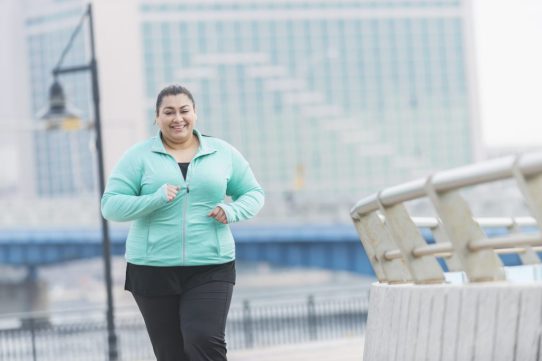
Yes! Find a physical activity that you love and move your body at least 30 minutes every day.  This is in keeping with the NIH recommendation to do moderate to vigorous activity for at least 30 minutes a day, five days a week. Moderate means: Walking, cycling less than 10 miles per hour, gardening (such as raking, digging, or trimming shrubs), dancing, water aerobics or playing in the park with your kids or grandkids. Vigorous means: Running or jogging, walking fast, cycling fast, heavy yard work (such as chopping wood or shoveling snow), swimming laps or playing a sport like basketball or fútbol. At De Las Mías, we want you to LOVE YOUR BODY! Move it! Dance it! Walk it. Bike it. Run it. Grow a garden with it. Please it. Be proud of it. Stop comparing it. Move it as much as you can, at least five days a week for 30 minutes a day and give yourself a big ¡Eso! Move your body in a way that affirms the love you have for yourself and your desire to be healthy and strong. The De Las Mías journey to a healthy life is a fun, and affirming way for Latinas ¡Unidas for a Healthy Life! The De Las Mías app is free and ready for download in the Google Play Store. Follow us on Facebook and Instagram @delasmiaslife.   Ref:  Bacon, Linda. Healthy at Any Size:  The Surprising Truth About Your Weight. BenBella Books, Inc.  Dallas, Texas. 2008 Callahan, Alice. Is BMI a Scam?  https://www.nytimes.com/2021/05/18/style/is-bmi-a-scam.html.

¡Hola, Guapa!, English, Healthy Body, Healthy Comadres, Healthy Family

Five Steps to Living a Life with Ganas and Salud

So You Have Diabetes, Comadre…

First of all, remember, you are strong, you are powerful.  You are Latina.  Even with all the diabetes in our families and communities, Latinas still live longer than anyone else.

We are made of strong stuff.  So even though we have diabetes, we still live longer than anyone else.  Now let’s live, not just longer, but also healthier!  We can do it. Let’s take care of ourselves con Ganas y Salud!

When it comes to diabetes, taking care of ourselves comes down to several steps.

  1. See a Certified Diabetes Educator.
  2. Eat Healthy.
  3. ¡Actívate! Get active, already.
  4. Manage your stress.
  5. Get support.

  1. See a Certified Diabetes Educator. The first step in taking care of your diabetes is to get good advice from an expert.  If you have insurance, are on Medicare or Medicaid, find out more about DSMES.

DSMES is the Diabetes Self Management Education and Support Program.  This program offers special diabetes education and management services to people with diabetes.  These are certified educators who know what they’re doing when it comes to diabetes.  They will help you figure out a plan that is tailored to  your needs.  Take advantage of it, if you can. If you are Medicare and/or Medicaid, DSMES may be free.  Find out more. There are other very good resources in the United States for other diabetes education and support.  There is a program called the Diabetes Self-Management Program and the Chronic Disease Self-Management Program that offer classes.  You will learn a lot about diabetes self-care and you will make friends! Contact your local health department for information about these free classes.  They are sometimes available in Spanish.

  1. Eat Healthy. What does that mean?  We are going to give you some simple guidelines, from the CDC.  This is an easy way to eat healthier when you have diabetes. 

The Plate Method

Eating healthy when you have diabetes is all about controlling your blood sugar levels.  Starchy vegetables and processed grains like white flour, white rice, white flour tortillas and white bread are just some of the foods that will raise  your blood sugar levels.  These kinds of foods can cause you problems. Learn to eat these kinds of foods in a more moderate way, and your body will thank you. It doesn’t mean you can never have cake or bizcochitos or empanadas.  It just means you need to take care of yourself by being careful and medida.  Nothing wrong with being medida. (Didn’t your mama always tell you that?) The plate method is a simple, visual way to make sure you get enough nonstarchy vegetables and lean protein while limiting the amount of higher-carb foods.

Here’s how to use the Plate Method:

  • Start with a 9-inch dinner plate.
  • Fill half with nonstarchy vegetables, such as salad, green beans, broccoli, cauliflower, cabbage, peppers, verdolagas, pepinos, and carrots.
  • Fill one quarter of your plate with a lean protein, such as chicken, fish, turkey, beans, or eggs.
  • Fill one quarter with carb foods. Foods that are higher in carbs include grains, starchy vegetables (such as potatoes and peas), rice, pasta, fruit, and yogurt. A cup of milk also counts as a carb food.
  • Choose water or a low-calorie drink such as unsweetened iced tea to go with your meal.
  • Look in our Cocina for Diabetes Friendly Recipes.
  • Learn to make more veggie dishes.
  • Snack on veggies like carrots, pepino con chilito, green beans, celery and jicama, also con chilito y limón.
  1. ¡Actívate, Ya! Get active already.  You don’t need to join the gym or get expensive equipment.  Start with 30 to 45 minutes of activity every day.  You can go for a 20 minute walk in the morning and 20 minute walk in the afternoon. You can mix up up. 

Get a bike! Ride your bike for 30 minutes. Work in your garden for 20 minutes and go for a walk for another 20 minutes. Walking is free. Find a safe place to walk. Call your Comadre and get out there, Girl! Being more active will help you control you blood sugar and may help you get to a healthier weight. Don’t delay. Do it today.

  1. Manage your stress. Stress is not good for anyone but it is especially hard on people with diabetes.  Learn about deep relaxation. There are many free resources online that can help you manage your stress.  Even taking 10 deep  relaxing breaths every few hours will help you reduce stress.  Go stand under a tree for 5 minutes and be still.  Take a walk around your neighborhood and look at the flowers. Pray the rosary. Or use prayer beads in your own way. 
  2. Get support. Moral support is very  important for people with diabetes.  Avoid isolating yourself when you feel sick or low energy.  Call a Comadre and complain.  Go for it.  Join a support group.  Take a diabetes self-management class and make new friends who also have diabetes.  Reach out to your friends and family and share your feelings.  Find people who will not judge you when you don’t stick  to your plan or eat something that makes you feel guilty. 

Remember, you can live well with diabetes.  You are strong. You are powerful. You are Latina!  And you live longer than anyone else!  That’s good news! Now live your healthiest life so  you can live that long life con ganas y salud.

¡Hola, Guapa!, English, Healthy Comadres

So You Have Diabetes…

When Emma first found out she had diabetes, she just took to her bed and cried. She didn’t escape “the curse.”  That’s what she called diabetes after watching her mom go blind and her cousin lose his leg.

Her daughter Josie found Emma curled up like a baby on the couch.

“It doesn’t have to be a curse, Mom.”  She said.

With her mom’s permission, Josie called her mom’s doctor about the new diagnosis.

“It is shocking at first,” the doctor said, “but there are ways to control diabetes and your mom is a strong, smart woman, and we will help her figure it out.”

Then the doctor shared some good information about diabetes with Josie.  And now, Josie was reminding her mom that she could live a good and healthy life even with diabetes.

“Even my nana had diabetes.” Emma said, still feeling the grief of the new diagnosis.

“But this isn’t your nana’s diabetes, Mom.”

Emma sat up on her bed and looked at her wise daughter.

“This is your diabetes, Mom, and we are going to help you make the very best of it.”

This is just one story of countless stories we Latinas have witnessed and lived, and the declaration — “This is not your nana’s diabetes,” is an important one.

Diabetes care has come a long way since our grandparents and uncles and aunts suffered through this devastating disease.  And by all estimations, diabetes can still be devastating to us as Latinos.  But it doesn’t have to be that way.  And this is what this article is about.

Support for People with Diabetes:

  1. A person with diabetes is not “A diabetic.” They are not the condition.  They have a condition, but it is not their identity.
  2. A person with diabetes needs family support. That means helping not judging.  Avoid punishing or guilting people with diabetes when they overeat.  This is not helpful, and can be harmful.
  3. Offer pro-active support to the person with diabetes, such as, “Mom, let’s buddy up and go for a walk.” Or “Mom, let’s look at new veggie recipes on De Las Mías and see what we can cook up for dinner.”

If You Have Diabetes…

  1. Diabetes education works. Ask the primary doctor in charge to refer you or your loved one to a certified diabetes educator.
  2. There are amazing classes that help support people with diabetes. Start at your local health department and find out about the Chronic Disease Self-Management Program and the Diabetes Self-Management Program.  Both of these programs were developed by Stanford University and are proven to help people with diabetes.  Most of these classes are free.  Find out more here: wcdc.gov/learnmorefeelbetter/programs/diabetes.htm.  There is also the Diabetes Self-Management Education and Support Program that is more tailored to your own specific needs around diabetes. They are free or low cost depending on your health care.  You can learn more about DSMES at:  www.cdc.gov/diabetes/dsmes-toolkit/index.html.  These resources are available in Spanish and English and they are evidence- based which means  you can trust the information and they are proven to work.
  3. If you have diabetes, remember, moderation is the key to diabetes management. You don’t have to give up your beloved foods or your way of life to take care of your diabetes.

Here are some healthy eating tips from the American Diabetes Association:

  • Eat more fruits and vegetables!
  • Eat lean meats and plant-based protein, such as beans.
  • Eat less sugar.
  • Eat less processed foods.
  1. If you are confused about how to eat when you have diabetes, ask your doctor to refer you to a certified nutritionist. Look up diabetes friendly recipes on the De Las Mías App!
  2. Get active! Get at least 30 minutes of physical activity every day for a total of 150 minutes a week. Mover your body. You can do any activity that moves your body, including housework, gardening, walking, swimming, dancing, cycling.
  3. Reduce your stress. Stress is not good for anyone but it is especially not good for people with diabetes. Learn to meditate. Praying the rosary can be a form of deep relaxation.  Learn other deep relaxation technique like Tai Chi or Yoga.
  4. If the doctor prescribes meds, take them!
  5. Be a partner with your doctor. If you don’t like how a medication feels, call them. Ask for your doctor’s help.  Don’t be shy! You deserve good diabetes care.
  6. If you have diabetes, remember, “this is not your nana’s diabetes.” You can live a rich life of wellness and happiness and have diabetes.
¡Hola, Guapa!, Edición No. 3: Stay On Track, English, Healthy Family

8 Tips on Hiking with Your Kids

“I’ve always loved nature. When Marty and I were dating, we would go hiking every weekend. It was my favorite way to stay fit. And for me, going for a walk is essential to manage stress. When the children came, I wanted them to also enjoy this beautiful and healthy activity.” “At first I was nervous to take the boys out into the country. They have always been restless and have a lot of energy,” Liz tells us. “I imagined Ricardo breaking an arm climbing trees while Agustin fell over a cliff for running instead of walking.” Liz soon learned that taking children under the age of 6 on a “real hike” was not realistic. “I realized that they were just too young for a regular hike and I had to adjust.” She then came up with a new plan. “For the little ones, the plan was to get outdoors, enjoy a nice day and play. By the time they’re 7-9, they can be taken on longer hikes.” Liz was determined to inspire the love of the outdoors in her children so step by step, poco a poco, she and her family started a beautiful tradition. “We started slowly and little by little we became a family of explorers. Now my boys love hiking and the outdoors.  We spend wonderful times together out in nature. It is one of the things that makes us feel stronger, healthier, and bonded as a family.”   Here are some tips from Liz on how you can enjoy the great outdoors with your children: 1. Involve the Whole Family and Other Friends: Let’s face it, exercise is more fun when done with the people you love. Invite your abuela, tía and fellow super-mamás to get active in the great outdoors. Hiking is a perfect low-impact, group activity for people of all ages and fitness levels. It doesn’t have to be a long hike to start.  Start with an hour or two. Or go for an hour, rest, have a snack and come back. 2. Keep it Easy & Make Plenty of Time: Especially for your first few adventures, choose a hike that’s short, on a mild incline, and has a great destination to look forward to. Waterfalls, lakes and vistas are all great choices, but if your little ones get sidetracked along the way, no worries! It’s about the journey, not the destination, so give your kids plenty of time to look around and investigate. 3. Be Prepared For Everything: As a proud super-mamá, we know you’re prepared to handle just about anything. But the trail can throw some unexpected surprises at you. Be sure to pack these 10 essentials.

  • Map or guide
  • Sunglasses
  • Sunscreen
  • Extra clothing
  • Flashlight
  • First-aid supplies
  • Matches
  • Knife
  • Extra food
  • Charged cell phone

You might also want to pack some kid-friendly items like a magnifying glass, binoculars and a safety whistle. No matter the weather, dress the entire family in layers. Bring rain clothes, hats and gloves in case of chilly or wet weather, and an extra set of clothes for after the hike in case the little ones get wet or muddy. 4. Take Breaks & Stay Positive: If you are going for a longer hike, 2 hours or more, remember that hiking takes a lot of energy. Frequent rests for healthy snacks, water and exploration will help keep your child’s energy — and your own — in tip-top shape. While wandering, use positive reinforcement to help your kids feel good about trying something new. Make sure to tell them how awesome they are! 5. Play & Follow the Leader: Letting your little ones lead the way can help them feel empowered — just be sure to change leaders so everyone gets a turn. This will help them feel invested in the end destination and ensure you’re setting a kid-friendly pace. To keep things fun, play a game along the way. Try counting all the different kinds of birds, flowers or types of trees you see so the trip is not just fun but educational! 6. Leave No Trace: Hiking helps you create healthy lifestyle habits not just for the family, but for being mindful of taking care of the environment. Bring a bag for your trash or make a game of collecting trash you see on the way back to the car. Pass on the value that together we can help take care of nature so we can all enjoy it. 7. Hike Often: Make hiking a family tradition. Tradition can be a powerful motivator, especially for families and friends. Take turns planning the adventure with other moms or family members by choosing one weekend a month to start. Help your kids look forward to the trip each time by letting them help choose the destination and pack their own supplies.  Just have a checklist ready to make sure you have everything you need. 8. Track Your Trip: Use the activity tracker in the De Las Mías app to track your hikes. Tracking your hike will help you and your family see your accomplishments. It will also show the progress you’ve made on your journey to embrace a joyful, healthy life. Download the De Las Mías App to track all your activities and learn more about maintaining a healthy life. Share your goals and success stories with your friends, comadres and families. Now that you’ve got these tips in your back pocket, get out there and explore!

¡Hola, Guapa!, English, Healthy Body, Healthy Comadres

De Las Mías Tools for Healthy Living – ¡Actívate, Ya!

Can we talk about physical activity?

Did you know that over half of Latinas in the United States are not physically active?

“Latinas are the largest, fastest growing female ethnic minority in the USA and also report the lowest level of physical activity.”(1)

“It is estimated that the number of deaths due to physical inactivity is similar to the number of deaths due to smoking.” (1)

“It is estimated that that just over half (52%) of Latina girls born in this century will eventually develop diabetes.” (1)

At De Las Mías we like to say “We are strong.   We are powerful.  We are Latinas.”

These research findings are a call to action, ¡Comadres!  If we, as Latinas, are to claim our rightful place in the world, raise strong, educated and healthy children, we have to take back this power and get moving!

What does it mean to be physically active?

Physical activity means moving your body, at a moderate intensity, in a way that uses up energy. It includes walking, dancing, running, cycling, hiking, climbing, swimming, lifting weights, doing yoga, stretching, gardening, running after your kids,  and any other activity that you do when you move your body to use energy.

The Physical Activity Guidelines for Americans recommend that adults get at least 150 minutes of moderate-intensity aerobic physical activity or 75 minutes of vigorous-intensity physical activity, or an equivalent combination each week.(2)  That means 30 minutes a day for 5 days.  AND, you don’t even have to do it all at once.  You can go for 15 minutes in the morning and 15 minutes in the afternoon or evening.  You can do it in the park or you can do it on safe street or you can do it at the mall.  Heck, I know someone who does it in Walmart! BUT YOU CAN DO IT!

Here are some of the benefits of physical activity:

  • Gives you energy.
  • Improves your mood.
  • Improves your confidence.
  • Improves your sex life.
  • Helps you manage stress.
  • Helps you get to a healthier weight.
  • Helps lowers your risk of heart disease, diabetes, and some cancers.
  • Helps lower blood pressure.
  • Helps you be a better role models to your children.
  • Helps you be more admired by our friends and family.

Barriers to Being Physically Active:

The research shows that when it comes to barriers to becoming more active, Latinas list time, energy, safety and lack of knowledge about physical activity as the main reasons why they don’t get more active. These are all real good reasons but we challenge you to find a solution, ¡Comadres!

It is ironic that lack of energy is a reason why some of us don’t get out there and move our bodies, yet, research shows that moving our body will give us energy!

Silver Linings –

But here are some encouraging research findings that we can grab on to:

¡Dime con quién andas y te dire quién eres!  Tell me who you “walk” with and I will tell you who you are!

Social support is key to physical activity:

  • Latinas who know people who exercise are more likely to be physically active.
  • Latinas who have physically active friends are more physically active.
  • Latinas who even report seeing people exercise in their barrios are more likely to be active than those who don’t report seeing people exercise.
  • Dancing as a form of physical activity among Latinas is more common than in other groups.
  • Providing free classes in the park or other safe spaces for groups to be active work for Latinas.
  • Walking groups with comadres, friends, and family are effective ways to get Latinas to be more active.

So, how about it, Comadres? 

What’s your ¡Actívate, Ya! Plan?

Can you think of one fun way you can mover you body this week?

Can you commit to moving your body, poco a poco, until you build up to 30 minutes per day?

Who can you ask to go with you?

Don’t you deserve unos minutitos to go out with your comadre for unos mitotitos?

Remember our SMART Goal technique.  

  • To make a plan, use the SMART Goal technique.
  • Everything goes better with comadres.
  • Share your SMART Goal with her.
  • What else do you need to prepare? Do you need a water bottle, a new pair of sneakers? A baseball cap to keep the sun out of your face.  A raincoat to go for a walk in the rain. A walking stick for the pesky dog.
  • Look at the Actívate, Ya! Features on the App. Learn to track your ¡Actívate, Ya!

References:

https://www.cdc.gov › physicalactivity › basics

https://salud-america.org/why-telling-latinas-to-just-exercise-is-a-big-mistake/
Physical activity in Latinas: social and environmental influences

https://www.ncbi.nlm.nih.gov › articles › PMC3868363

¡Hola, Guapa!, ¡Hola, Sabrosa!, English, Healthy Body, Healthy Comadres

De Las Mías Tools: Recipe for Success

Setting S.M.A.R.T. Goals

Do you want to be healthier, more powerful and lead a much more supported life?  We want that for you too! And we are here to help.

As the old dicho goes, “Del dicho al hecho es largo trecho.”  –  From saying it to doing it is a long stretch of road.

We are here to give you tools for your trecho.

Another old dicho, this one from our Chinese antecedents is, “When the student is ready, the teacher appears.”  If you’re ready, we’re here. We would be happy to be your teacher.

At De Las Mías we talk a lot about making positive changes that will take you on the road to a healthier life.

Here is a tool for your toolbox: It’s called S.M.A.R.T. Goals. SMART stands for Specific, Measurable, Attainable, Relevant, Timely.

We believe that anytime we want to make a change, we first must be ready for it.  So, consider this…

  • Have you been thinking of making a change in your life?
  • Have you been thinking of eating more fruits and vegetables?
  • Have you been thinking of getting out on a daily walk?

If you have been thinking about making healthy changes, chances are you are ready to go from thinking about it to doing it. But, to make a change, you need a plan. It isn’t enough to say you’re going to do it. You must take yourself to the next important step.

Setting S.M.A.R.T. Goals

Learning how to set goals is a powerful exercise.  Here is a well-tested tool that may get you on the road to making healthy changes in all areas of your life.  It’s called the SMART Goals tool.  Try it! Share it with your comadre.  Let us know how we can help!

What does SMART stand for?

Specific – This means you give details to your goal.  For example, you don’t just say “I am going to be more active.”  You say, “Today, I am going to start walking for 30 minutes and I will do it 3 times per week.”

Measurable – How will you know that you met your goal?  Keep track and measure it.  It could be as simple as writing it down on a post it and put it on your fridge.

If you use the De Las Mías App, keep your phone with you and the App will track your steps and record it for you.   Some people wear Fitbits or some other kind of wearable.  This is another way to measure your goals Now, you can even sync your wearable to the De Las Mías App.

Attainable – This means your goal is possible for you. For example, if your feet hurt when you walk, then it’s probably not attainable for you to set a walking goal of 30 minutes.  You could try 10 minutes at a time and build up.  You could try some other form of being active such as dancing, cycling, or swimming.  The important thing is to set a goal you can do.  Be realistic and get better results. Don’t shoot for the moon on the first try.  Slow and steady wins the race.

Relevant – Does your goal make sense to you?  Do you believe that it is important?  Does it fit with who you want to become?  It has to be something you want and that you believe has value.  Otherwise, it won’t work.

Timely – Set a time for when you are going to do it and for how long.  Some women even put it on their calendar.  Setting a goal for a week at a time is better than setting it for the whole year.

Here is an example of a SMART Goal.


Starting tomorrow, I am going to walk for 20 minutes during my lunch break.  I am going to walk every other day for this week.  At the end of the week, I will check in with myself and my comadre and see if I need to change my goal for next week or keep this up until I feel satisfied.

We believe that the SMART Goal tool works better if you have someone to share it with.  Sharing a goal helps keep us accountable and it is a powerful way to make healthy changes.  This is where your amigas and comadres come in.  Share your SMART goal with someone who cares about you and wants you to succeed.

¡Buena suerte!

¡Hola, Guapa!, English, Healthy Comadres

Latinas and Mental Health in the Time of COVID19

25 Things We Can Do to Take Care of Our Mental Health

We are in a crisis, Comadres. The COVID19 pandemic is taking its toll on us. The crisis is real and our community is suffering. According to the American Psychiatric Association the Hispanic/Latinx community are at high risk for physical, mental and financial problems due to the COVID-19 pandemic. A new report by this association of respected mental health professionals states that in some areas of the country such as New York, Oregon and Utah, Latinos are getting infected with COVID at a much higher rate than White people. We are much more likely to have to go to the hospital and almost 3 times more likely to die from the disease than our Anglo brothers and sisters.

It’s Not Your Fault

There are very sad reasons for this and we are not blaming ourselves for this terrible tragedy but there are still some things we can do to not fall victim to COVID19 and its consequences.

As a Latina, we know you are LA MERA-MERA FREGONA in your household and that you have the power to convince your family members and friends to take care of themselves.

Here are 25 things we can do to take care of ourselves and address some of the mental health problems caused by COVID19. Most of these suggestions are from the American Psychiatric Association, but we added some of our own.

  1. Reach out and get support. Stay in touch with your friends and family via phone, WhatsApp or other technology. As a thank you to customers ZOOM is lifting the 40-minute limit for all meetings globally from midnight ET on Nov.26 through 6 a.m. ET on Nov. 27 so your gatherings don’t get cut short!
  2. Get in touch with your community churches and community centers for other sources of information and support.
  3. Eat healthy foods. – For those nights when you’re feeling uninspired about cooking follow us into our cocina for nutritious easy to cook at home recipes!
  4. Drink lots of water. – Try our free DLM app to use our checklist to track your daily 6 glasses of water. Share and check in with your comadres to keep each other motivated and hydrated!
  5. Get good sleep if you can. – Rub some eucalyptus oil or lotion on for some stress relief aroma therapy to help you relax before bed
  6. If you believe in prayer, pray. Remember your Abuela’s rosary?
  7. Meditate. If you don’t know how, learn. – We love following @wocsistercollective_ and @_ana_lilia for breathing workshops, guided meditations and community circles.
  8. Take a walk every day. –  Take a daily walk for at least 10 minutes, we recommend that you always bring a mask with you! The American Hiking Society share FAQ’s for hiking and playing outside during the time of Covid
  9. Reach out and help others, but without risking your health.
  10. Obtain free food from your local food bank. – Hunger Hotline 1-866-3-HUNGRY or 1-877-8-HAMBRE for Spanish for information about meal sites, food banks, and other services near you. Or text 97779 with a question that contains a keyword such as “food” or “meals”. The hotline is managed by the US Department of Agriculture (USDA)
  11. Donate food if you can afford to. (Some neighborhoods have their own food pantries.)
  12. If you have a chronic illness like diabetes, high blood pressure or another condition, don’t put off your medical care.
  13. Listen to music. – Put on “La Bicicleta”  by Carlos Vives and Shakira and go out for a bike ride in the morning to start your day off dancing and with some fresh air!
  14. Get out into nature. Listen to the birds. – When you go, be prepared for closures. Many facilities are closed, including visitor centers, parking lots, bathrooms and even entire parks. Check the park or agency website for the latest information before you go, and even then, be prepared with extra water, food, hand sanitizer and yes, even your own toilet paper. You don’t want to have to stop for food or supplies and risk exposure.
  15. Share your story of bravery, kindness and resiliency with others.
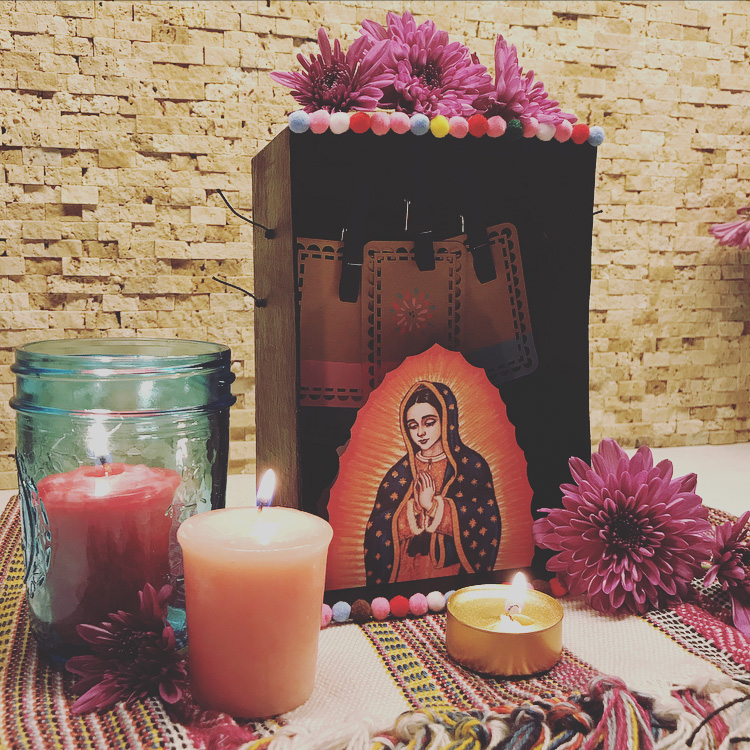
  16. Connect to your cultura! Traditions, such as making shrines, doing limpias, or safely lighting veladoras will lift your spirits.
  17. Make your favorite foods from your culture. A good pozole or caldillo always feels restorative. – Make your favorite foods from your culture, a good pozole feels restorative! Feed your loved ones a healthy and delicious meal that will make them proud of their roots, and their panzas happy! Our easy-to-make pozole recipe can be found here https://atomic-temporary-200050569.wpcomstaging.com/lazy-sari-posole/
  1. If you can’t work, call to find out about unemployment benefits. Some rules have changed. – As of March 2020, states the option of extending unemployment compensation to independent contractors and other workers who are ordinarily ineligible for unemployment benefits. Please contact your state’s unemployment insurance office. Find Your State Unemployment Insurance Office (link: https://www.dol.gov/coronavirus/unemployment-insurance#find-state-unemployment-insurance-contacts
  2. Use hotlines to get help if you are feeling like you have lost hope. SAMHSA’s National Helpline is a free, confidential, 24/7, 365-day-a-year treatment referral and information service (in English and Spanish) for individuals and families facing mental and/or substance use disorders.The NAMI HelpLine is a free, nationwide peer-support service providing information, resource referrals and support to people living with a mental health conditions, their family members and caregivers, mental health providers and the public.
  3. Take a break from the news.
  4. Watch out that you are not taking in false information. Trust the Centers for Disease Control for information about COVID19.
  5. Keep following safety precautions. Don’t lose faith in science. Follow social distancing advice. Stay at least 6 feet away from people.
  6. If you can’t be 6 feet away, wear a mask that covers your nose and mouth.
  7. Y por amor, pónte la mascara. Wear a mask indoors when you are with people who don’t live with you.
  8. Don’t give up.  Help is on its way!


¡Venceremos!

What story would you like to share with your Latina hermanas about coping during the time of COVID?

Please share that others may be healed and comforted by your experience.

Source: Corona Virus, Mental Health and Hispanics in the United States – American Psychiatric Association – This resource was prepared by the APA’s Council on Minority Mental Health and Health Disparities and the Division of Diversity and Health Equity. It was authored by Emily Paulsen and reviewed by Vabren Watts, Ph.D and Eric Yarbrough, M.D.

¡Hola, Guapa!, English, Healthy Body

Self Care in the Time of COVID

Self Care and Weight Gain

Are you gaining weight?  I heard from one of our comadres the other day via  Facebook, and she cried out “Help!  ¡Ayúdame!  I’ve put on a bunch of weight and it’s really stressing me out.  I can’t stand it anymore when I look in the mirror!  What am I going to do?”

It was a plea like the ones from the vintage Mexican lonely-hearts comic book, ¡Ayúdame, Doctora Corazón! Only Doctora Corazón helped mend broken hearts.

Our Hearts are Broken

But our hearts are broken, aren’t they? These crises we are living through are some of the worse times we will ever experience in our lifetimes.  COVID19 is destroying the lives of thousands of our Native, Latino and Black brothers and sisters all over our land.

Health disparities have come home to roost and it’s a pesadilla of mammoth proportions. Black Lives Matter are taking it to the streets and to our screens. This pandemic is a public health crisis, but racism is a public health crisis too and they have converged.

We hit the boiling point, hermanas.  These are hard and distressing times, and many of us are comforting ourselves and our families with food, which is completely understandable. We are consuming fritangas, chatarra, and chicharrones, as if our life depended on it.  As if we had no other choice.

And who can blame you?  Aren’t you taking care of a bunch of people right now, Super-Mujer?  I bet you are!  I bet you are bringing home the frijoles, cooking them and serving them up to a multi-generational montón de gente, and to top it all off, you aren’t even getting your nails or  hair done.

I speak from experience.  You should see my Covid hair! ¡Dios me salve, María!  And you know as well as I do that I do not look distinguished, okay?  That is a bunch of Malarkey como dice el Tío Joe.  I look like I’m 69 years old!  (Oh wait!  I’m 69 years old!)

But here’s the deal.  I’ve said it before and I’ll say it again, because at my age I get to repeat myself:  Los chicharrones son muy traicioneros!  They will turn on you like a bad boyfriend. No matter how simpaticos they look next to your Michelada, they are not your friend.  De vez en cuando, like at your cousin’s wedding pos-boda, they’re okay.  Delicious! Go for it!  ¡Aviéntate! But getting into the habit of overeating in the time of COVID is probably not going to make things better.

Let’s be honest. Are you giving up dieting?

(That’s a trick question. I want the answer to be, “yes.”)

Change Can Happen

During disruptive times like these, sometimes good things happen. Like Uber, there can be a disruptive technology. Change can happen.  So maybe women will finally give up dieting.  Maybe women like you and me, old and young, abuelas, tías, hijas, comadres, hermanas y madrinas will just say.  “Ya basta con las dietas, ”and start taking care of ourselves in the true sense of the word.

The Importance of Self Care

We have been doing a lot of  Self Care content on De Las Mías lately because we know how stressful these times are and how many responsibilities you have. Latinas are the hub of our families, remember?  We are the sun of the solar system we call familia.  Don’t be in denial about that, hermanas!  You know who you are!  You know that you are working full time, taking care of your mama, and your kids and your Viejo, who refuses to be controlled by you, and your sobrino is dropping out of high school, and you dread for his life.  You know these “truths to be self-evident.”

But what if in the midst of this DESMADRE, there is a dawning of a new age and I don’t mean Aquarius?  What if the dawning of a new age comes down to Latinas actually engaging in Self Care?  What if women like you and me would consider Self Care more seriously than having our hair and nails done?  What if Self Care means more than shopping for cute clothes, eating in front of the TV, or going out for a socially distancing happy hour with the girls?

My Hope For You and Me

My hope is that Self Care for you and me will mean that we take care of our bodies, our minds and our spirits, that we treat ourselves to good, healthy food, that we celebrate con muchas ganas, without being reckless with ourselves, that we move our glorious bodies and feel joy instead of a sense of duty. That we go back to dancing for the fun of it,  biking down tree-lined avenues like when we were girls or going out for nature walks with our  families.  What if those of us who survived this pandemic, took this crisis and turned it into an opportunity to become truly strong, healthy, and, yes, CHINGONAS?  What if we develop the ovaries and the confidence to demand we get paid what we’re worth? What if we stopped believing what the mass consumer market tells us about who we are, what we should look like and how much we should weigh? What if we start claiming our worth?

So, let’s send diets packing and claim our power to be strong and healthy, and yes, PODEROSAS.  Let’s tell the truth when we say, “We are strong.  We are healthy. We are Latinas.”