¡Hola, Guapa!, Edición No. 2: Support, English, Healthy Comadres

Better Together: How to Start a Comadre Support Group

We have just finished analyzing the results of our 2 year De Las Mías study! And our research confirms that a healthy lifestyle journey goes better if you have a comadre by your side! Yes, it’s true. Supportive friendships have been proven to help us make our lives better, and health is no exception. Social support and supportive friendships are keys to making healthy changes and having a healthy life.

In our work with our comadres at De Las Mías, we have come across several great ideas on how to nurture healthy and supportive relationships. Would you like to have a group of women support you in your healthy lifestyle journey? You can do that by inviting your girlfriends, comadres, madrinas, hermanas and tías to download the app and join the De Las Mías digital community. You can also start your own in-person De Las Mías Support Group. Here’s how!

How to Create a Comadre Support Group

1. Make a date


Invite 3 to 5 of your best friends and comadres who are ready to start living a healthier lifestyle. Agree on how often you will meet. We recommend once a week for 4 weeks. Then decide if you want to continue to meet once a week or go for every two weeks. This might be stating the obvious, but do what works for your group.

2. Take Turns


A great way to build support and confianza is for each person to take 3-5 minutes and give an update of what is on her mind without interruptions or advice. This is great practice. I don’t know about you but my comadres and I are constantly interrupting each other! You get your own special 3 minutes to say what is on your mind. Then the next comadre takes her turn.


3. Ask First


After you go around the circle and each one has shared without interruptions, you can respectfully ask if they want advice. If they say yes, offer your words of wisdom.


4. Speak from Your Own Experience


Try to speak your own truth. Say things like, “This is what worked for me,”  or “This is what I did that really helped.” Avoid saying, “You should…”


5.Share Your Goals


¿Sabes qué? Research shows that if you tell someone that you are making a change it increases your chances of sticking to it. Next time you are having a group meeting or even just sharing a private cafecito with your best friends, state your goal out loud. “Comadre, I am committing to cutting back on Gummy Bears.” (Or Oreo cookies, or chicharrones, or Doritos. You get the picture.)

Getting together on a regular basis to share your goals, frustrations and progress will get you to your healthy goals a lot quicker than doing it alone. Plus, it will be more fun!

Activities for Your Comadre Support Group

  • Do you want to walk more and sit less? ¿Sabes qué? If you commit to going on a walk with your comadrita 3 times a week for just 15 minutes, you are much more likely to do it. You might even do it for longer!
  • Start a Healthy Lifestyle Group at work. If you are lucky enough to get an hour for lunch, eat your lunch for 30 minutes and then go for a healthy walk for 30 minutes. If you can’t go for 30, go for 15! We know a group of 3 teachers that pitch in and buy the makings for healthy salads for lunch for the work week. They share the cost of the groceries, make healthy salads to share, and then go for a 20 minute walk. They feel great and have even shed a few pounds without getting obsessive and ‘all loca’ about it. Try it!
  • Is there a pretty street or an interesting neighborhood that you have often admired on your way home from work? Gather your comadres in your car-cancha, drive there and then go for a long walk. If you’re lucky enough to live in a town with a plaza, like Santa Fe, Albuquerque or Mesilla, New Mexico, cruise around the plaza and take in the beautiful adobe architecture of your ancestors.
  • Design a treasure hunt! Get some fun little objects like a shell, an old door knob, a porcelain duck, and an old teddy bear. Hide the objects around your neighborhood or the nearby park. Give your crew some clues and go walking for treasures. Take the kids or take your kid at heart.  
  • Make my day and go for a De Las Mías group bike ride! Take pictures and share them with us so we can post them on our Instagram feed! (I have a bias! I LOVE MY BICI! And I want you to love your bici too!)
  • Walk and pray! I am not kidding. I found a group of comadres and compadres in Silver City, New Mexico that used to pray the rosary while they walked laps around the field of the local high school.  
  • Do you have a book group? How about getting together to discuss an article from the De Las Mías blog? Combine it with a healthy potluck from our delicious collection of De Las Mías recipes.
  • Find a cause! Once you form a comadre support group, find a cause you can all support. If you can’t give money, give time. Make a difference in your community.
  • Craft day! Pick a date once a month or every three months and get together with your comadres to do something with your hands. We come from a long tradition of women getting together to sew, knit, and embroider. Start your own tradition with  your supportive friends and comadres. I have a group in Hood River, Oregon that gets together to make Valentine cards, or hand-made regalitos.
  • Have a clothing exchange party! Each comadre brings 2-3 items of clothing that they want to share. Bring 3 and take 3, or give away what doesn’t get exchanged to a good cause like Salvation Army, St. Vincent’s de Paul, Goodwill or the local Women’s Shelter.

There are many ways to get together with your comadres to improve your chances of living a healthier, more joyful and more supported life! It really helps if the comadres in your group also want to live a healthier life. You may all be in different stages of the journey (and that’s okay!), but doing it together builds confianza and success. Share your goals, your frustrations and your triumphs. We are better together, Comadres!

¡Unidas for a Healthy Life!

¡Hola, Guapa!, Edición No. 2: Support, English, Healthy Comadres

With a Little Help from Our Comadres: Part Three

As Latinas, warmth comes naturally to us—and being a supportive friend is important. With help from our comadres we can achieve a healthy, content and successful life.

How to Be More Helpful to Your Comadres

Dr. James Prochaska, a well-respected researcher on making healthy lifestyle changes, offers the following advice to those looking to be a more supportive friend.

Show Empathy

When your friend is considering a change, one loving and kind thing you can do is be empathetic. Show her you understand.

Dr. Prochaska states that when people are thinking about making a change, they can feel like they want to take action but have self-doubt at the same time.

As a helpful comadre, you can let your friend know that you understand how hard making a change can be, and that you are there to support her as she tries to move into action.

Ask, “How Can I Help?”

It’s a good idea for the person asking for support to say what kind of support she needs. This isn’t always easy, so the helper may need to prompt her friend to ask for what she needs.

Miriam asked how she could help and I told her. You may also want to give your friend permission to tell you what is not helpful.

As the helping comadre, don’t fall into giving advice right away. Wait for your friend to ask for what she needs, or ask her, “What can I do to help?”

Show Warmth

As Latinas, warmth comes very naturally to us. We are lucky that way. We know how to show cariño.

It is a good reminder to show authentic cariño and acceptance for your friend. Give authentic feedback. You can say something like, “I know how hard it can be to make changes and I know you’ll do the best you can.”

De Las Mías is about helping one another succeed. When we have a strong support system, we can be more successful. Trust the journey, trust in each other.

Want to know more about living a healthy life in an atmosphere of kindness and support? Read part one and part two.

¡Hola, Guapa!, Edición No. 2: Support, English, Healthy Comadres

With a Little Help from Our Comadres: Part Two

Last week we learned that researchers have validated that the strong bonds we have as Latinas in our traditional familias and friendships protect us—and can help us make healthy changes.

This week, I want to share a personal story and una práctica (a practice).

A Balanced Life with Help From Our Comadres

Miriam and I have helped each other through many life changes—including the death of her husband, my divorce, raising our daughters, becoming more prosperous, building our careers, decorating our homes, preventing and managing diabetes and, above all, living a healthy and happy life.


Each year, around the first day of Autumn, we get together and go through a plática process we started over 20 years ago. We make a list of the 7 most important areas of our lives and review our progress and make vows for changes for the following year.

  • Personal Relationships
  • Aspects of Health and Wellness
  • Aspects of Prosperity
  • Living Environment
  • Career and Work
  • Creative Expression
  • Care of the Soul

We go through each of the seven areas of our life and take turns speaking with no interruption or cross talk. We just listen to what each has to say and make no comment until the end.

We answer four basic questions for each of the seven areas:

  1. What went well?
  2. What didn’t go so well?
  3. What would we like to change?
  4. What kind of help do we need from each other?

Using this process has helped the two of us accomplish many things throughout the years. We have improved our careers, become wiser mothers, better partners, more creative writers and artists.

We have made more money and avoided making expensive interior decorating mistakes. We have both become healthier and happier and, oh yeah, we have both lost about 25 pounds each.

Continued Success with a Supportive Friend

Our annual conversation is one of the most valuable and consistent things I have done with my life and my comadre and supportive friend, Miriam, for 20 years. Our friendship has grown and deepened. We are in our 60s now, and it is fair to say that we are more fulfilled and happy as a result of this bond that is based on listening to each other, tracking each other and caring for each other’s happiness.

In the area of health and wellness, Miriam and I have made great progress. We have used this method for achieving a healthier, more balanced life.

This year, I shared with Miriam that one aspect of health and wellness that went very well for me last year was biking. (I bike six miles a day!) She smiled without comment. Just seeing her face made me proud of myself.

When I shared aspects that didn’t go so well, I shared that my arms felt like mush. Again, no judgment from her. Just a nod that she was hearing me.

When I got to Question Three—what I would like to change—I told her that I needed to keep up my arm strength, that I wanted to be a strong old lady, one who can pick up her own suitcase and put it in the overhead compartment. She still looked at me wisely and smiled.

And when we got to Question Four, Mir asked, “How can I help?”

After thinking a bit, I said, “I guess I need some suggestions, since I really detest going to the gym to lift weights.”

That is when Miriam finally spoke to give me advice. She said, “First of all, you don’t have to go to the gym if you don’t like it.” She then suggested that I get some exercise bands and told me about a YouTube video she used when she started doing arm-strengthening exercises. Knowing me and my love of television, Miriam even suggested I keep some bands by the couch!
I vowed to try it twice this week just to see how it would go.

She gave me a high five and asked, “Do you want to check in with me next week, and let me know?”

I accepted her offer and told her that I could also just shoot her an email or a text.

I then did the same for her. Her goal was to increase her walking by five minutes a day, three times a week. We went through the same process and vowed to check in and help each other out.

Miriam and I trust each other—we have confianza. Sometimes we admit to each other that we don’t want to do what it takes, that we aren’t ready for change.

Just admitting that we are struggling helps break down the barriers. Sometimes we are successful and sometimes we aren’t, but we are always faithful about helping each other without judgment. We know that each of us only wants the best for the other. We both feel supported and cared for.

Having a comadre, a supportive friend, in your life can help you achieve a healthier, happier life. This plática process is a concrete way to get help from our comadres.

Learn more about how to be a supportive friend in part three.

¡Hola, Guapa!, Edición No. 2: Support, English, Healthy Comadres

With a Little Help from Our Comadres: Part One

Health researchers tell us what we already know, that the Latin American family has some built-in protective factors related to the closeness and support we get from our extended families. Although most of us Latinas already know that, it sure is nice to have it affirmed by scholars and health researchers.

We know from experience, the value of our familias, and we know that our fierce love protects us. Now researchers are recognizing these strong bonds as something positive and they call it “protective factors.”

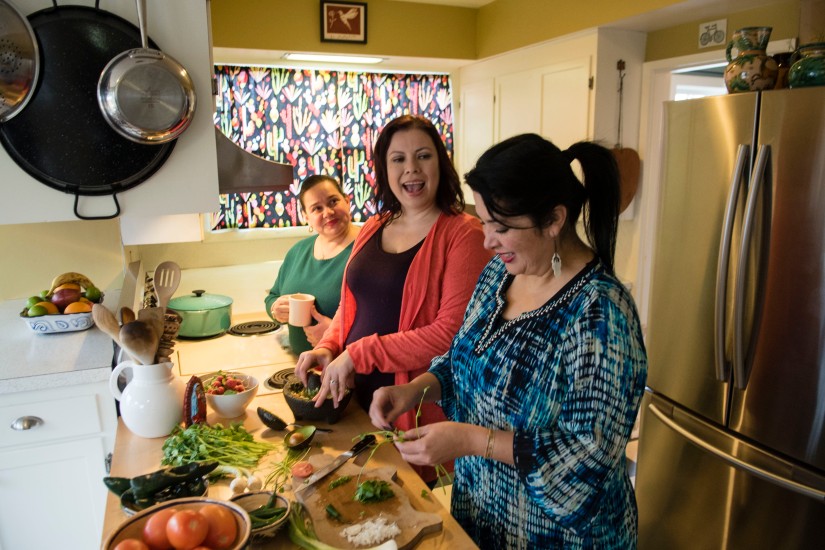
Women in kitchen 2

A Healthier Life with Help From Our Comadres

We don’t need fancy nouvelle cookbooks to tell us how delicious, varied and nutritious our food is. We know our comida rocks, but now there are hundreds of new books on the marvels of the Latin American kitchen.

Just as we already know how important our families and our food are to us, we also know what the research has confirmed about female friendship and support. A recent study conducted by Brown Medical School and University of Minnesota found that women who joined a weight loss program with a supportive friend were much more successful than when they joined alone.

Latinas have always had strong female bonds that uphold and protect us. And now the research affirms that this bond can help us achieve a healthier life.

Next week I’ll share a personal experience about how my comadre, Miriam, and I have been peer-coaching each other for more than 20 years, with stellar results. Check out part two and learn how Miriam and I helped each other through many life changes.